JWST measurement of early black hole challenges cosmological timelines
First direct mass measurement of a supermassive black hole in the early universe reveals an object 40 million times the mass of the sun existing just 700 million years after the Big Bang.
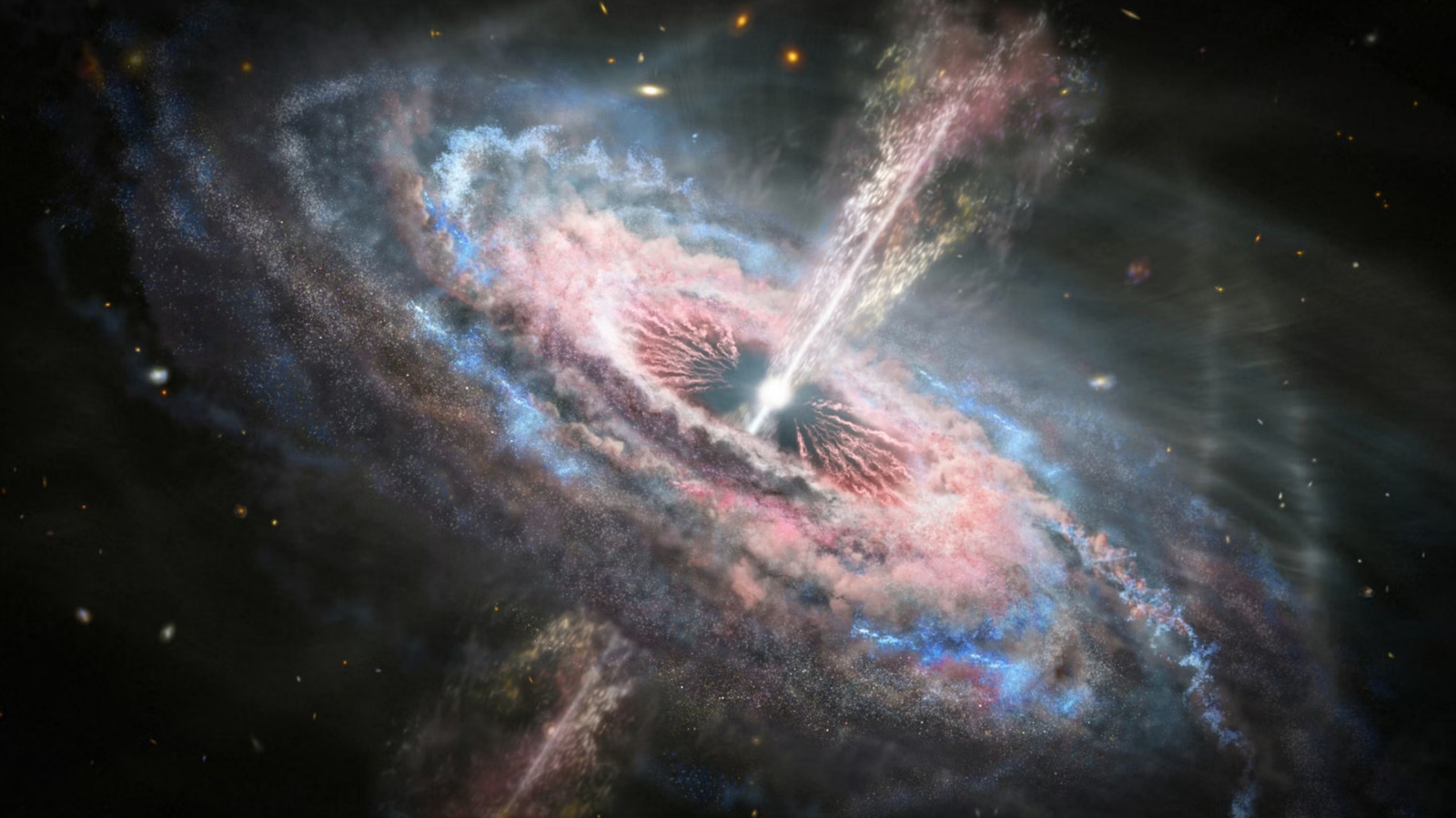
The James Webb Space Telescope has delivered the first direct mass measurement of a supermassive black hole in the early universe, a discovery that upends established astrophysical models regarding the timeline of cosmic structure formation. The object, designated Little Red Dot QSO1, is located 13 billion light-years away and existed approximately 700 million years after the Big Bang. Weighing 40 million times the mass of the sun, the black hole appears to have formed rapidly without undergoing the standard stellar collapse phase, potentially predating its host galaxy.
Conventional scientific wisdom has long held that supermassive black holes form from the collapse of large stars within existing galaxies, subsequently growing by accreting nearby material. This process typically requires at least one billion years to produce objects of such magnitude. The discovery of Little Red Dot QSO1 challenges this view, with researchers suggesting the object may have formed within the first second after the Big Bang. Professor Roberto Maiolino from Cambridge’s Cavendish Laboratory and Kavli Institute for Cosmology described the findings as requiring a total revisiting of the classical scenarios of black hole formation and growth.
The mass was calculated by observing the Keplerian rotation of gas surrounding the black hole. This motion, similar to planets orbiting the sun, is governed by simple laws of gravity and indicates that the mass is concentrated in the central black hole rather than distributed among stars. Study co-author Dr. Francesco D'Eugenio noted that prior methods relied on indirect assumptions from local universe black holes, whereas this method uses direct gravitational dynamics to determine mass with precision.
Researchers observed that the gas exhibits Keplerian rotation, which allowed for a precise mass calculation. Ignas Juodžbalis, a researcher involved in the study, stated that this confirms most of the mass of QSO1 is concentrated in the black hole at the center. If the mass were more distributed, as it would be if there were a lot of stars, the gas would not have this perfect Keplerian rotation. This marks the very first direct measurement of a black hole mass within the first billion years after the Big Bang.
Theoretical models suggest that dark matter decay may explain such rapid formation, although this remains unproven. Astrophysicists at UCLA have proposed that dark matter decay could accelerate formation by heating hydrogen gas, allowing gravity to condense it into giant clouds more rapidly. However, the existence of dark matter remains theoretical, with no concrete information regarding its makeup or confirmation of its existence. While calculations paint dark matter as a likely culprit to make the math work, the theory requires further validation.
