Inherent’s Faraday agent outperforms frontier models at replicating scientific research
London-based AI startup Inherent claims its new agent, built on a compact 27-billion-parameter model, has surpassed larger systems from Anthropic and OpenAI in independently reproducing published scientific findings.
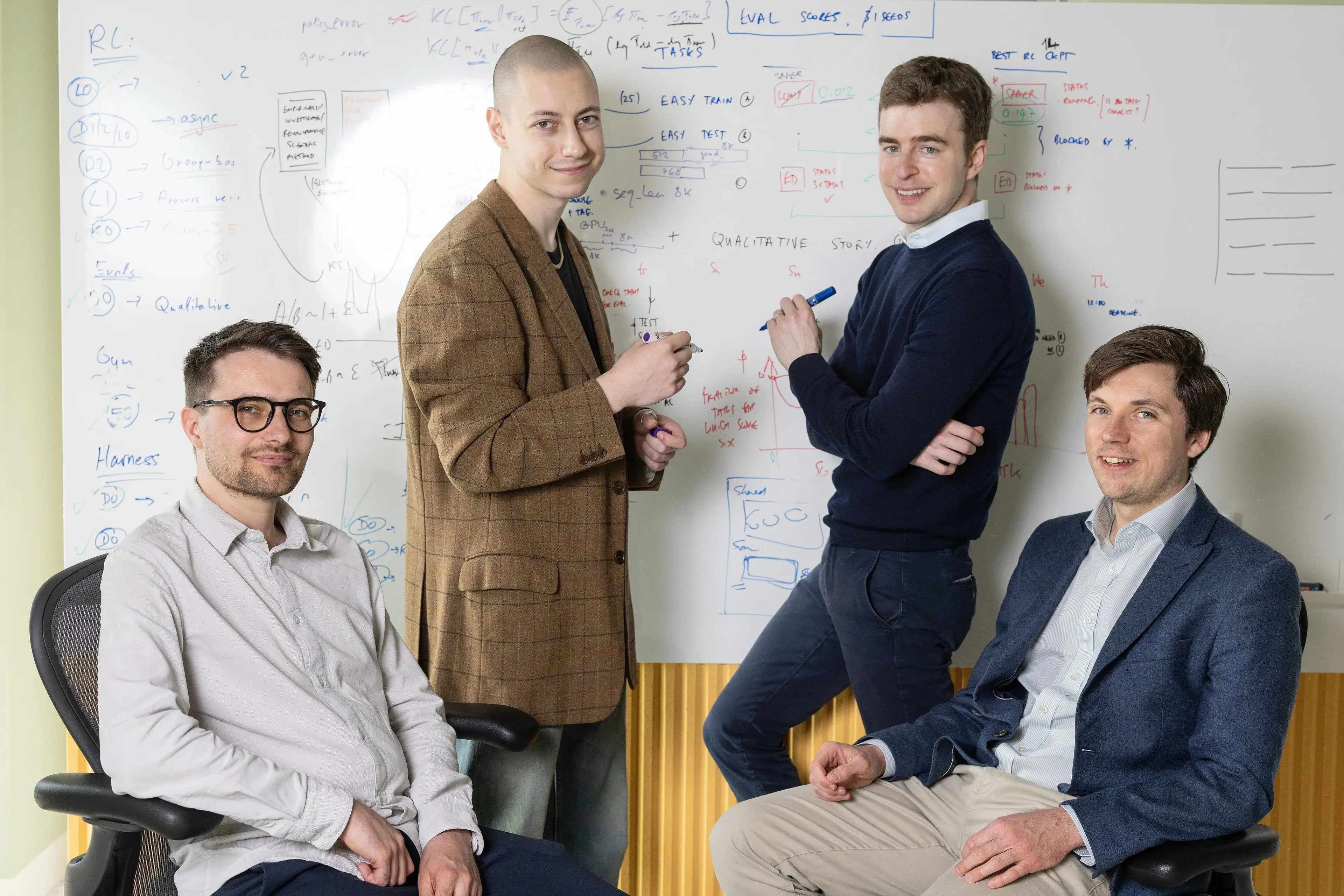
Inherent, a London-based artificial intelligence laboratory founded by alumni of Google DeepMind, has released an AI agent named Faraday. The company states that the agent outperformed significantly larger models from Anthropic and OpenAI at the specific task of independently replicating the findings of published scientific papers. This achievement marks a concrete milestone for the startup, which emerged from stealth mode just weeks ago after securing a $50 million seed round.
Faraday operates on a comparatively small model known as Qwen 3.6, which contains 27 billion parameters. By contrast, the agent was benchmarked against Anthropic’s Claude Opus 4.8 and OpenAI’s GPT-5.5, both of which are much larger frontier-scale systems. The disparity in size suggests that efficiency and targeted training may be driving performance in this specific domain, rather than raw computational scale.
The company’s approach relies on reinforcement learning to develop what cofounder and chief scientist Edward Hughes describes as “research taste.” This method rewards the AI for good outcomes rather than explicitly spelling out the rules of scientific conduct. Hughes noted that replicating papers is a standard training exercise for human scientists, often undertaken by PhD students, making it a relevant benchmark for an agent aiming to eventually discover new knowledge.
Inherent has also made deliberate choices regarding its technology stack. Rather than developing a proprietary coding tool, the company utilises OpenAI’s GPT-5.5 Codex for coding tasks within the Faraday agent. This decision mirrors how human scientists often rely on existing software infrastructure rather than building every component from scratch, allowing the team to focus on the agent’s scientific reasoning capabilities.
The startup is headquartered in King’s Cross, a London neighbourhood that has become a major AI hub largely due to the presence of Google DeepMind. Inherent currently employs 12 staff members who work in person at the office. The company plans to expand its workforce to between 20 and 25 employees by the end of the year, a move that could attract talent from the broader DeepMind ecosystem, particularly as uncertainty persists regarding the new role of DeepMind’s leadership.
Hughes has also highlighted the impact of UK labour practices on the startup’s growth. He has cited the practice of “garden leave,” which restricts departing employees from joining rivals for a set period, as a disadvantage compared to US startups. Despite these regulatory headwinds, Inherent continues to position itself as a collaborative partner in scientific research, aiming to build agents that act as curious teammates rather than simple answer engines.