Humanoid robots break sprint records at Beijing games, but practical tasks reveal limits
The second World Humanoid Robot Games showcased record-breaking athletic feats in Beijing, yet experts warn that mechanical failures and reliance on human teleoperation suggest the technology is still far from general-purpose autonomy.
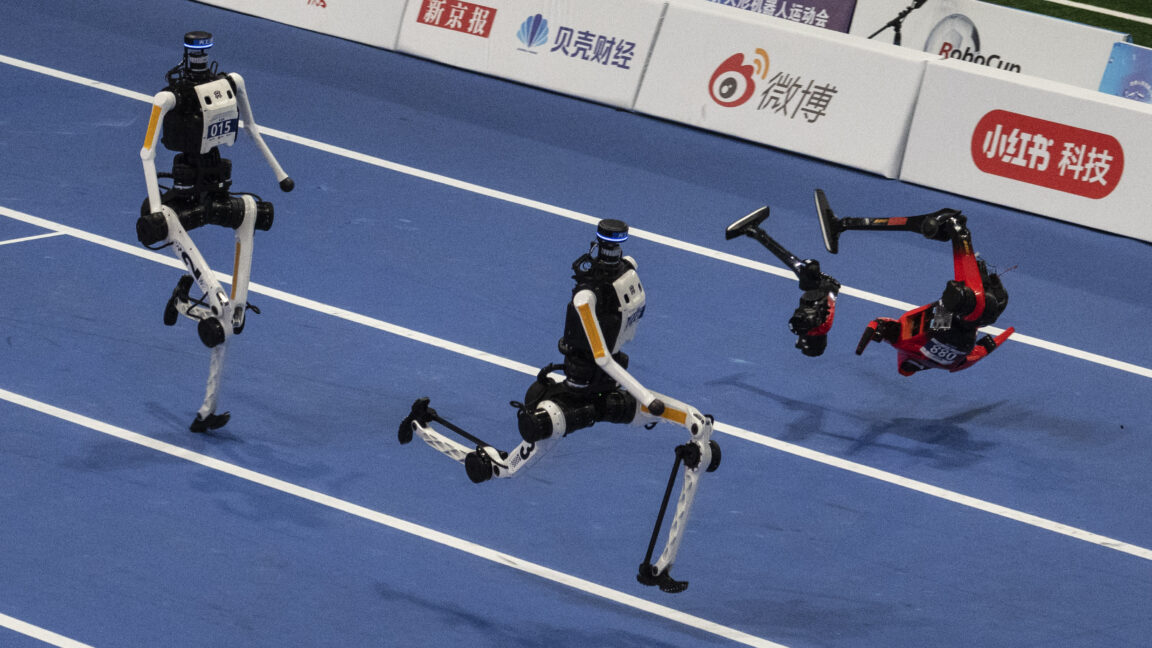
The second edition of the World Humanoid Robot Games, held in Beijing from 22 to 26 August 2026, marked a significant milestone for the robotics industry as humanoid units surpassed human world records in the 100-metre sprint and standing high jump. This achievement contrasts sharply with the inaugural event in 2025, where robots generally lagged behind human record-holders. The improvement signals substantial progress in whole-body control, according to Dipam Patel, a PhD candidate at Purdue University, who noted the engineering push required to coordinate all joints for specific tasks.
However, the spectacle was marred by mechanical failures that highlighted the limitations of current hardware. Several sprinting robots crashed into barriers or fell because they could not readily stop after crossing the finish line. Some units broke at the waist in a shower of sparks or caught fire due to overheating. These incidents underscore that while robots are becoming faster, they remain task-specific and often lack the ability to safely decelerate or navigate unexpected obstacles.
Beyond the athletic events, the games introduced practical challenges designed to test commercial viability, including washing laundry, hotel housekeeping, and firefighting. In these scenarios, robots generally performed slower than humans. At the Beijing Continental Grand Hotel, units were tasked with moving wheeled luggage and restocking supplies, while a separate outdoor firefighting event required teams to identify hazards and extinguish fires. Only three out of 12 competing robot teams completed the entire firefighting challenge within the 30-minute limit.
A Beijing-based company, X-Humanoid, gained viral attention for a robot that won the small-group 400-metre race using an unusual posture described as a "shy person hiding behind their hands." The developers told the Global Times that the robot learned this technique through reinforcement learning trials in simulation, shifting from a standard arm swing to holding its arms near its face while swinging them through hip rotations.
Despite the impressive displays, experts caution that many competitors still rely heavily on human teleoperation or cloud computing rather than full autonomy. The games allowed for remote control in certain events, though scores were penalised if robots were not performing autonomously. Patel observed that many units were directly controlled by human operators, indicating that autonomous systems still have a long way to go before they can handle the edge cases of real-world environments without significant intervention.
The event serves as a showcase for the commercial potential of humanoid robots, a sector that attracted more than $6 billion in investment in 2025 alone. Chinese firms are particularly aggressive in deployment, while US companies such as Boston Dynamics and Agility Robotics are ramping up commercialisation plans. As the industry moves from demonstration to deployment, the focus is shifting from flashy athletic records to the reliability and generalisation of robots in practical, everyday tasks.