Hugging Face releases open-source humanoid legs to lower robotics R&D costs
The move contrasts with commercial units costing up to $150,000, aiming to democratise access to AI-powered robotics testing amid a sector facing margin pressures.
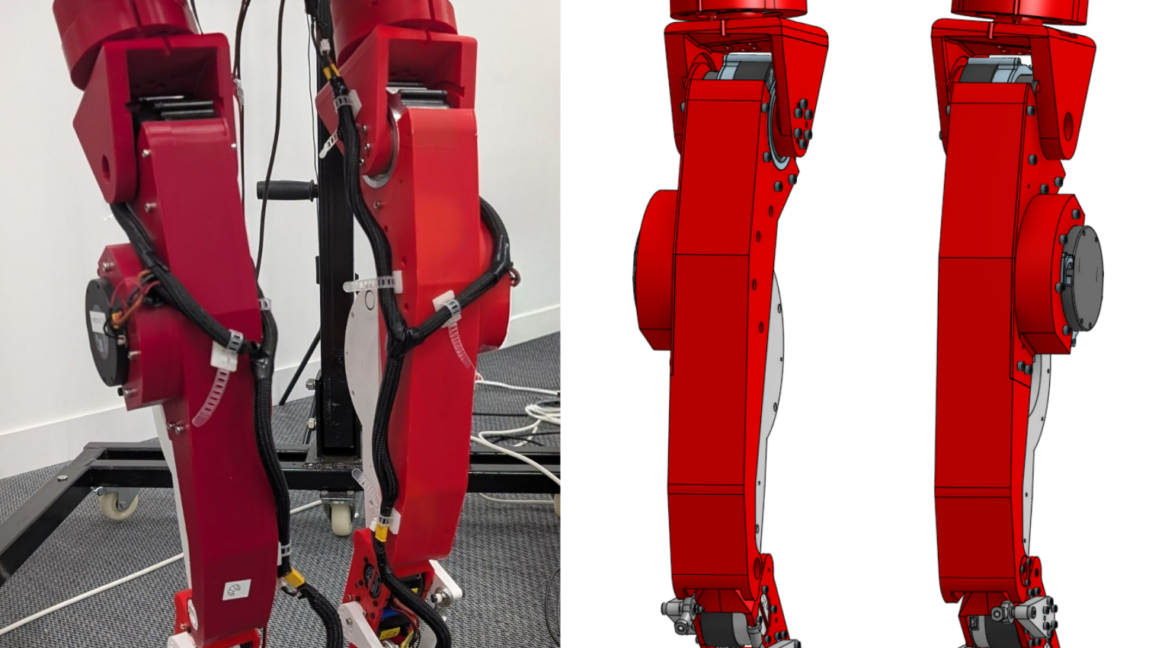
Hugging Face has launched the LeRobot Humanoid project, an open-source package comprising 3D-printable bipedal robot legs priced at approximately $2,500. Designed for researchers and builders, the release provides a bill of materials, printable part files, wiring documentation, and software tools for calibration and control in both physical and simulated environments. The initiative seeks to provide an affordable, repairable platform for testing AI-powered robotics software, standing in sharp contrast to commercial humanoid robots that typically cost between $30,000 and $150,000 per unit, according to an April 2026 report by McKinsey.
Virgile Batto, a robotics engineer at Hugging Face, stated the design prioritises affordability, mechanical performance, and ease of assembly over advanced capabilities. The goal is to create a practical balance rather than a high-end commercial product, enabling users to build, understand, repair, and instrument the hardware for learning experiments. The platform supports a full-robot design loop, allowing robots designed in simulation to be tested in physical bodies, with real-world data subsequently used to improve simulations.
This release follows Hugging Face’s previous launch of a 3D-printable robotic arm and coincides with broader industry efforts to reduce manufacturing costs. The company previously announced a collaboration with French firm The Robot Studio in May 2025 to develop the HopeJR humanoid robot, which features 66 actuated degrees of freedom and a target price of $3,000. Hugging Face is also selling a $299 robot called Reachy Mini, designed for expressive behaviours and human interaction.
The push for affordable robotics development occurs against a backdrop of significant capital inflows and competitive pricing pressures. Venture capital funding for robotics more than tripled between 2023 and 2025, surpassing $40 billion in 2025. Meanwhile, Chinese manufacturer Unitree Robotics sells models below $20,000 and is seeking a $610 million initial public offering on Shanghai’s Star Market, despite reporting a 53 percent drop in first-quarter profits amid a brutal price war.
In parallel, Hyundai Motor Group is reportedly considering mass-producing the Boston Dynamics Atlas robot at a manufacturing line in Georgia. Discussions include a US-based facility capable of producing 350,000 robotic actuators annually. Hugging Face CEO Clem Delangue has previously stated the company backs open-source robotics to mitigate industry dominance by large corporate interests, a stance reflected in the LeRobot Humanoid roadmap which includes future integration with an upper body and more advanced behaviours.
