Horizon Quantum Holdings Reports First Quarter 2026 Results as Liquidity Boosts Infrastructure Push
Horizon Quantum Holdings Ltd. (HQ) releases inaugural public quarterly report, highlighting strengthened balance sheet and strategic partnerships across multiple quantum architectures.
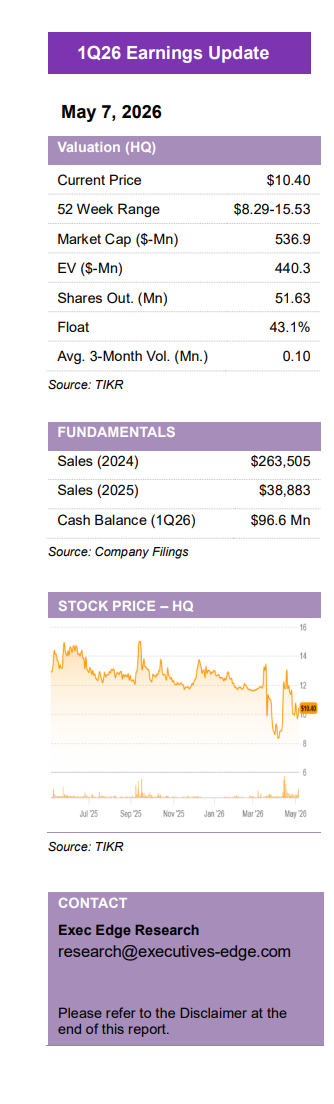
Horizon Quantum Holdings Ltd. has released its first quarterly report as a publicly traded company for the period ending March 31, 2026. Following its de-SPAC transaction with dMY Squared Technology Group, which closed in March 2026, the combined entity began trading on the Nasdaq under the ticker 'HQ'. The company reported a significant strengthening of its balance sheet, exiting the quarter with $96.6 million in cash and equivalents, up from $0.2 million at the end of 2025. This liquidity, supported by approximately $98.2 million in net proceeds, provides financial runway to accelerate research and development, hardware integration, and commercialisation efforts.
Strategically, the quarter reinforced HQ's positioning as a differentiated quantum software infrastructure platform centred on its 'Triple Alpha' stack, which aims to abstract quantum complexity for broader enterprise adoption. The company's software stack progresses through multiple abstraction layers, beginning with Hydrogen, a portable quantum assembly language, followed by Helium, an imperative quantum programming language, and ultimately Beryllium, an object-oriented quantum programming language intended to abstract away much of the underlying quantum mechanics from developers.
During the quarter, HQ continued advancing Beryllium toward a more feature-complete development environment while simultaneously strengthening interoperability with underlying quantum infrastructure. The company's focus on higher-level software tooling and runtime integration increasingly resembles modern accelerated computing frameworks, where developers can leverage advanced computing infrastructure without directly interacting with low-level hardware architecture. Over time, continued improvements in usability, abstraction, and runtime orchestration could materially expand the addressable developer ecosystem and accelerate broader enterprise adoption.
The company also highlighted a strategic shift toward in-house hardware integration with the launch of its first quantum computer, Ember-1, located at its Singapore headquarters. The system is based on a Rigetti Novera 9-qubit superconducting processor, Quantum Machines' OPX1000 control electronics, and a dilution refrigerator assembled internally by HQ. The launch positions HQ as the first quantum-focused software company operating its own quantum hardware stack rather than relying exclusively on third-party cloud access.
Partnerships with IonQ, Alice & Bob, and AQT materially expand HQ's multimodal ecosystem exposure across trapped-ion, superconducting, and fault-tolerant architectures. In April 2026, HQ announced a strategic agreement with IonQ that includes the planned deployment of a 256-qubit trapped-ion quantum system expected to be installed during calendar 2027. These relationships expand HQ's exposure across multiple competing hardware modalities and reinforce the company's broader objective of positioning Triple Alpha as a universal orchestration and development layer.
Financially, the quarter reflected the expected profile of a newly public, development-stage quantum infrastructure company aggressively investing in research and development, ecosystem integration, and public company readiness. Total operating expenses increased to $6.5 million in 1Q26 from $4.7 million in 1Q25, the widening loss was largely due to hiring, primarily for science and engineering teams. However, net loss improved to $3.6 million versus $4.8 million last year, supported by a $3.0 million non-cash gain from the fair value remeasurement of warrant liabilities.