Historical data points to strategic entry points for semiconductor and solar ETFs
A Yahoo Finance analysis of 34 sector ETFs suggests that SMH and TAN may offer buying opportunities following anticipated short-term pullbacks, based on patterns observed in previous market cycles.
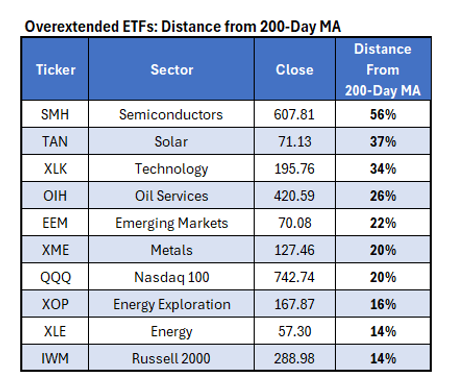
A recent analysis published by Yahoo Finance suggests that the VanEck Semiconductor ETF (SMH) and the Invesco Solar ETF (TAN) may present strategic buying opportunities if they experience short-term pullbacks. The report highlights that SMH has surged more than 60% since late March, placing it over 50% above its 200-day moving average and making it the top performer among 34 tracked sector ETFs. The Invesco Solar ETF (TAN) is identified as the next most overextended sector by this metric.
The analysis examined 16 prior instances where sector ETFs reached a similar extension of 50% above their 200-day moving average. In these historical cases, the ETFs averaged a 1% gain over the next two weeks but were down 0.6% on average over the following month. Over a one-year horizon following these signals, the ETFs averaged an 18% return, though they beat the S&P 500 ETF (SPY) only 33% of the time.
A separate analysis of signals where ETFs were 25% above their 50-day moving average showed a different trajectory. SMH signalled this level in early May, while TAN did so last Friday. In these scenarios, the ETFs averaged a 3% loss over the next month, with just 31% of instances beating the SPY. However, six months after these signals, the ETFs averaged a 13% return, beating the SPY’s 11.5%.
Looking further ahead, one year after the 50-day moving average signals, the ETFs averaged more than a 35% return, beating the broad market 61% of the time. The author notes that while the recent AI boom driving semiconductor stocks may be unique, the historical data suggests that surges above moving averages often lead to short-term pullbacks followed by strong medium-term performance.
Based on these results, the report advises monitoring SMH and TAN for a potential dip in the coming month. If the funds follow the typical pattern of short-term decline after such extended moves, it could present a favourable entry point for investors seeking exposure to semiconductors and solar energy sectors.