Google's Android Auto overhaul introduces 'full bleed' screen adaptation and advanced AI capabilities
Google has released a major update for Android Auto that fundamentally alters how the interface adapts to vehicle hardware, eliminating unused margins on curved and circular screens while integrating advanced AI for proactive message analysis and background app control.
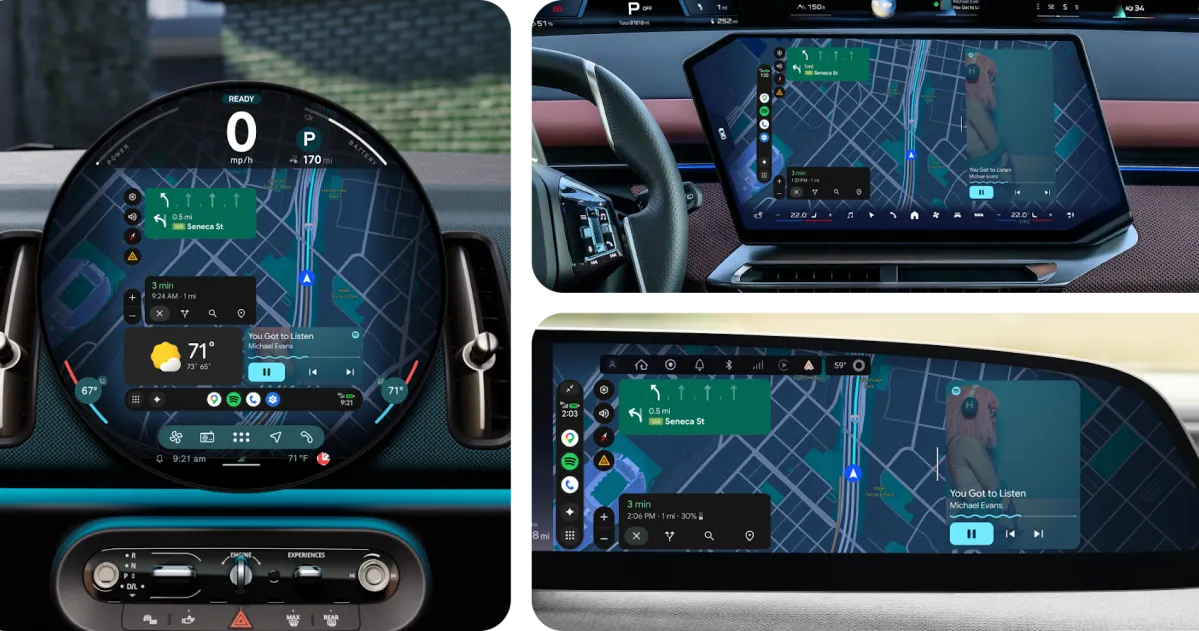
Google has released a major update for Android Auto, describing the changes as the most significant in the platform's ten-year history. The primary innovation is a new "full bleed" design that allows the interface to completely fill unconventionally shaped vehicle screens, moving away from the previous standard rectangular layout which often left unused margins on modern displays.
This adaptation specifically targets the irregular geometries found in contemporary electric vehicles. Patrick Brady, VP of Android Automotive at Google, highlighted examples such as the Lucid Air's curved display, the MINI Cooper's circular screen, and the BMW Neue Klasse's irregular trapezoid shape. The new system dynamically tailors the interface to these forms, ensuring applications like Google Maps can utilise the entire display area regardless of the screen's geometry.
Beyond visual adaptation, the update integrates advanced Gemini AI capabilities to reduce driver distraction. A feature dubbed "Magic Cue" proactively analyses incoming messages to suggest one-tap replies, such as retrieving an address for a text request. Additionally, Gemini now operates as an agentic go-between with third-party apps, allowing drivers to place orders through services like Starbucks and DoorDash via natural language commands without direct phone interaction.
The platform also adopts the Material Three Expressive design language, bringing youthful animations, bold fonts, and vibrant colours to the in-car interface. This design inherits personalisation cues from the user's phone, including wallpaper-based colour palettes, giving Android Auto a more integrated and customised appearance. Users can now project personalised widgets for sports scores, smart home controls, and contact shortcuts, which can be accessed and interacted with using natural language commands.
Further enhancing the user experience, Google Maps on Android Auto now features refreshed colours, detailed 3D buildings, and realistic terrain. In a notable convergence of technologies, the map running via phone projection is increasingly gaining capabilities previously reserved for embedded systems. This includes communicating with an EV's powertrain to automatically add charging stops or precondition the battery before arrival.
Safety remains a central constraint for high-bandwidth features. While the new design allows for YouTube video streaming in 4K with Dolby Atmos spatial audio, this functionality is restricted to when the vehicle is in 'Park'. The car informs the phone when it is stationary, unlocking the ability to stream 60fps video from the user's device to ensure safe driving practices are maintained.
