Flipper Devices unveils Linux-powered Flipper One networking gadget
The device, priced under $350, operates on a different layer than the popular Flipper Zero, focusing on network connectivity rather than radio frequencies.
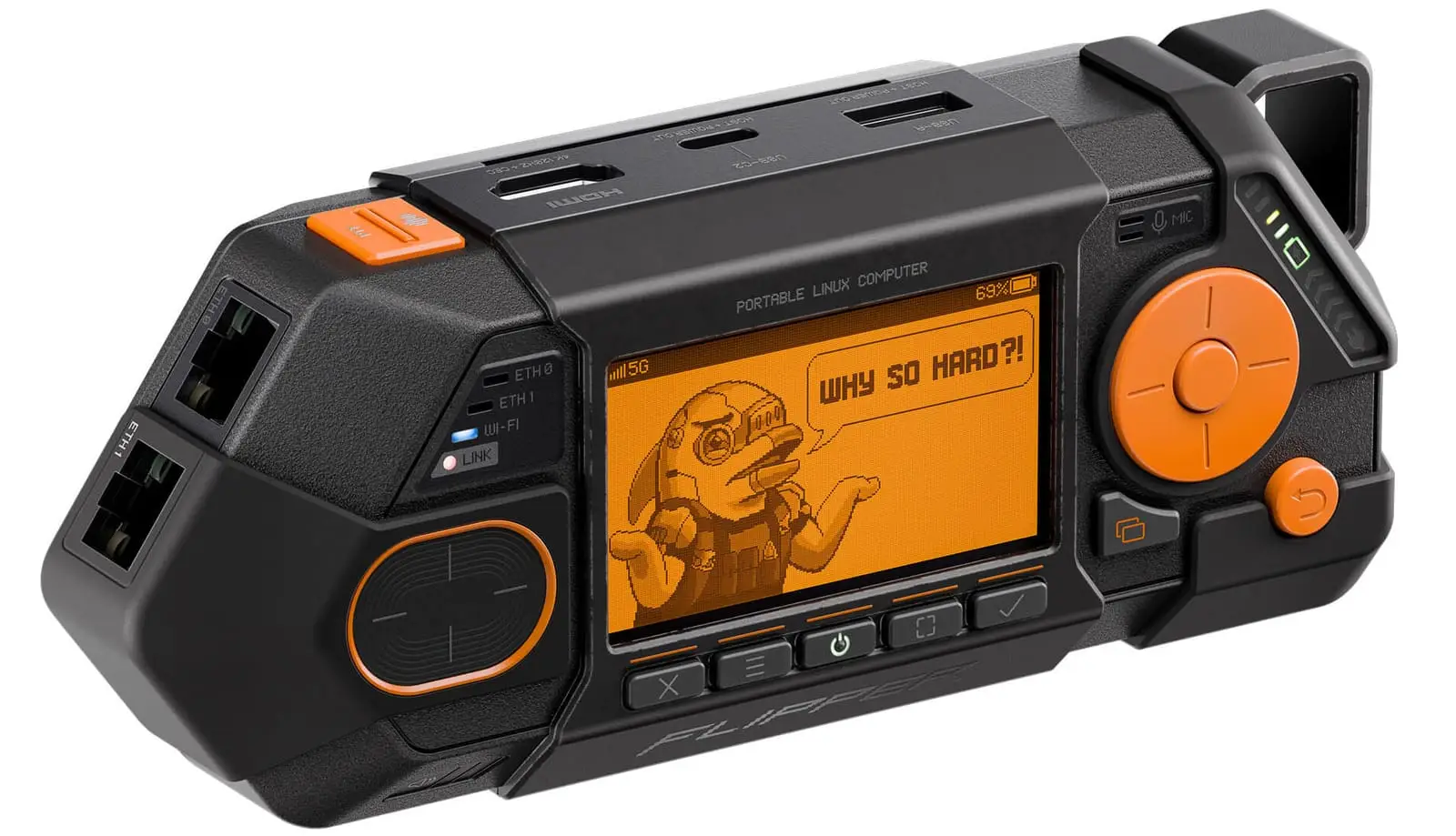
Flipper Devices has announced the Flipper One, a new networking gadget designed for hackers and tinkerers that runs on a Linux-based operating system. The company, which has sold over a million Flipper Zero units and generated more than $150 million in sales, clarified that the new device is not a direct successor but operates on a different layer. While the Flipper Zero focuses on radio frequencies such as Bluetooth, RFID, NFC, and infrared, the Flipper One is built around network connectivity, featuring dual Gigabit Ethernet, USB Ethernet, and Wi-Fi 6E.
The hardware specifications include an eight-core RK3576 chip running open Linux, paired with a Raspberry Pi RP2350 microcontroller and 8GB of RAM. The RK3576 chip includes a Mali-G52 GPU and a neural processing unit (NPU) intended to run local AI models. To ensure broad compatibility, the company collaborated with open-source software consulting firm Collabora to push support for the RK3576 chip into the mainline Linux Kernel, allowing users to download and tinker with the driver directly from Kernel.org.
Connectivity options extend beyond standard networking, with an M.2 port that supports 5G modems, software-defined radio modules, SSDs, and Wi-Fi cards. The device can function as a Linux PC, router, or VPN gateway. It also features HDMI 2.1 output capable of 4K streaming at 120Hz, allowing it to serve as an on-the-go media box when connected to a monitor, keyboard, and mouse via a USB hub.
Flipper Devices is currently developing its own Linux-based operating system, known as FlipperOS, which is in the concept stage. The company noted that while existing distributions like Raspberry Pi OS are fluid, they require re-flashing SD cards for clean resets. The new operating system aims to allow users to access profiles with pre-configured packages and perform clean resets without swapping storage media. Additionally, a new interface called FlipperCTL is being developed to control small screen LCDs using D-pad and touch controls.
The product is currently in development, with the base model price expected to be under $350, excluding cellular modules. The company has invited developers to join the community to help build the software required for the final device, acknowledging that key features such as NPU support for AI and hardware video decoding still lack mainline kernel support. Final details regarding the consumer launch will be announced at a later date.
