Field trials test autonomous drones as rapid response to US wildfires
As climate change extends wildfire seasons, agencies evaluate whether small-scale drone swarms and sensor-integrated systems can complement traditional aerial firefighting fleets.
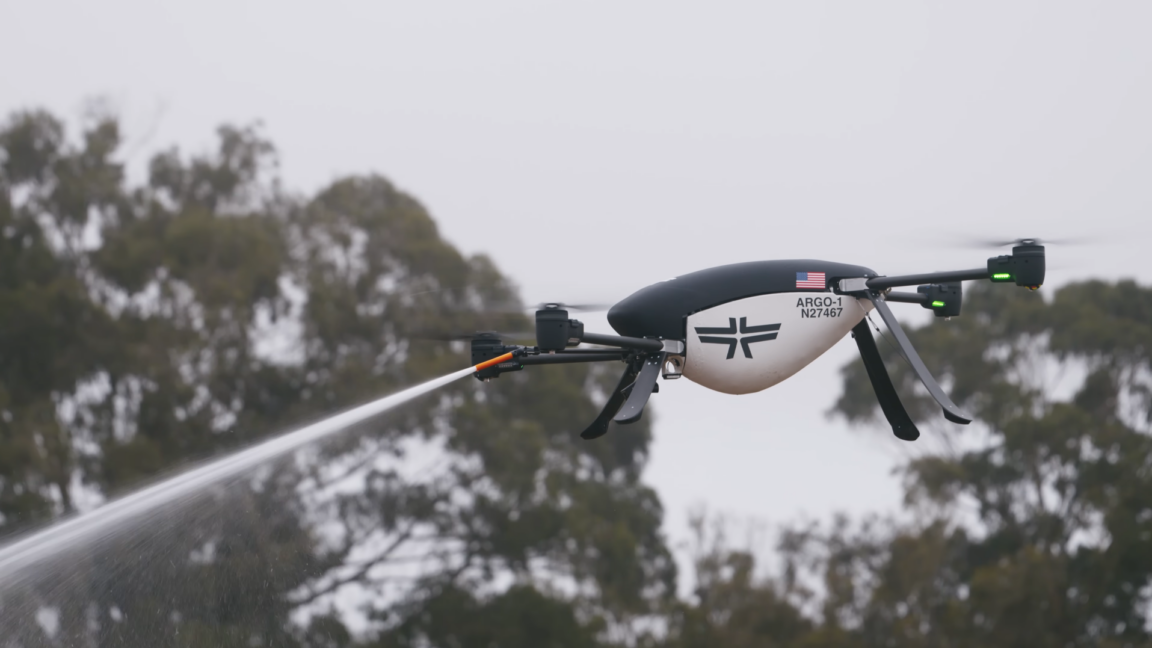
Autonomous firefighting drones have undergone field trials in California and Alaska this summer, testing their viability as rapid-response tools for early-stage wildfires. With climate change extending wildfire seasons into a nearly year-round risk across much of the United States, fire agencies and technology developers are exploring whether small-scale drones can suppress fires before they escalate, complementing the capabilities of large airtankers.
The California Department of Forestry and Fire Protection (CAL FIRE) conducted a field test on July 15 involving Seneca’s Argo-1 drones. Organised with assistance from the nonprofit FireWERX, the demonstration saw five autonomous units operating in a swarm to deploy between 500 and 1,000 gallons of fire suppressant foam. Each Seneca drone carries approximately 100 pounds of water or retardant and operates in groups of four to six units.
Seneca, which plans to make the Argo-1 drones commercially available in 2026, reported that the system relies on onboard sensors to identify heat signatures after a human operator uploads GPS waypoints. The drones hover at optimal altitudes and line up to spray sequentially. While fully loaded units have a limited range of 10 miles at an average speed of 30 miles per hour, they are designed for portability, fitting into the back of a pickup truck. The company aims for a two-minute turnaround time for refilling payloads and swapping batteries.
Separately, the XPRIZE Wildfire competition held finals testing in June 2026 near Fairbanks, Alaska, evaluating Dryad Networks’ Silvaguard system. The German-developed technology integrates solar-powered tree sensors with autonomous drones. When sensors detect smoke, an observation drone confirms the fire via infrared imaging before a suppression drone deploys up to 26 gallons of suppressant. The system utilises prepositioned solar-powered hangar pods to house the drones within the competition’s 1,000 square kilometre test area.
Market adoption is already underway for some systems, though not all major agencies have committed. The Aspen Fire Protection District in Colorado has secured a $5 million contract for five Seneca drones over five years. In contrast, CAL FIRE, which operates the world’s largest aerial firefighting fleet with more than 70 crewed aircraft, continues to evaluate the technology without having signed any drone contracts yet.
