Explosive drone incident at Leipzig airport prompts counter-terrorism inquiry
The disruption at one of Europe’s largest air cargo hubs has drawn links to Russian state actors and highlighted gaps in European drone defence infrastructure.
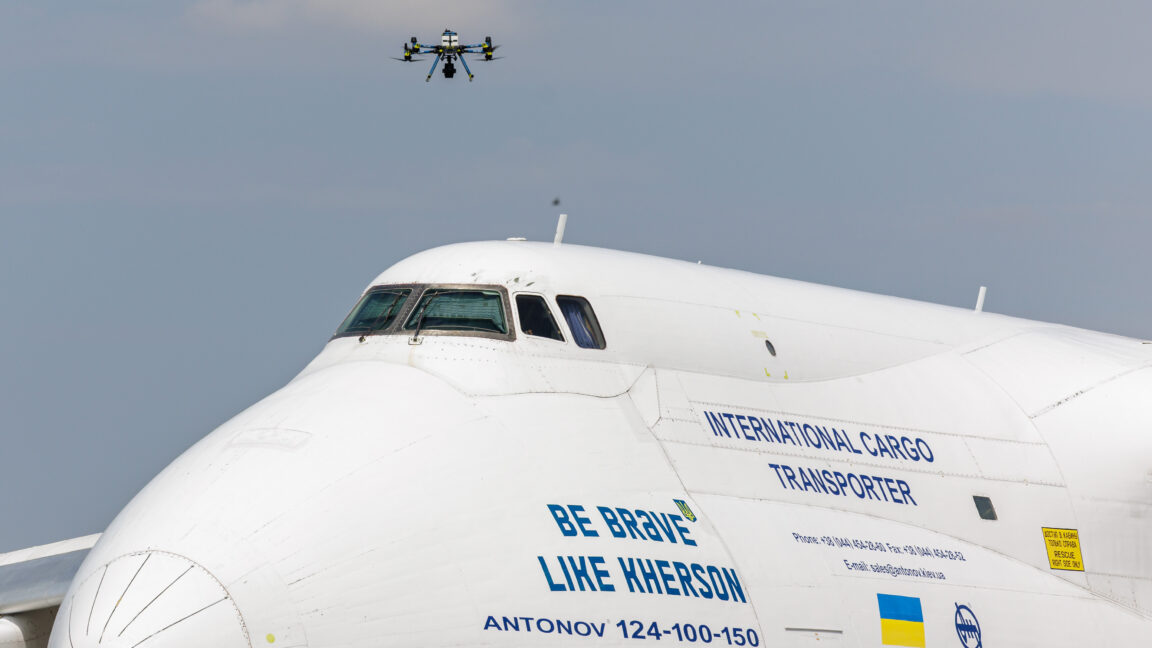
German police disarmed an explosive drone near parked Ukrainian Antonov An-124 cargo aircraft at Leipzig/Halle airport on August 4, 2026. The device, modified to evade detection sensors and carrying a fist-sized package of Semtex plastic explosive, failed to detonate due to a faulty detonator. The incident forced the airport to close for several hours, resulting in 19 diverted flights.
Federal Minister of the Interior Alexander Dobrindt confirmed the drone’s modifications and explosive payload during a press conference. He described the event as a hybrid threat scenario potentially involving foreign powers. German authorities have opened a counter-terrorism investigation and are examining the possibility of a second drone after a DHL-operated Boeing 757 collided with an unidentified object mid-air while climbing away from the airport. The aircraft diverted to Hanover with minor damage.
Contrary to some media reports, the German Interior Ministry denied that the targeted Ukrainian aircraft were carrying weapons or munitions. Officials stated the Antonov An-124 Ruslan aircraft were empty at the time of the incident. Leipzig/Halle airport serves as a major European air cargo hub and a transit point for NATO and German military shipments, as well as the home base for Ukraine’s Antonov Airlines.
The incident has drawn direct accusations against Russia. Roderich Kiesewetter, a lawmaker and member of the German parliament’s intelligence committee, described the event as an attempted act of terrorism attributable to Moscow. Additionally, pro-Kremlin propagandist Alexander Sosnowski expressed disappointment on Telegram that the attack failed, implying Russian involvement in the operation.
These events follow a rise in drone incursions across Northern and Eastern Europe since 2024, including closures at Munich airport and incidents in Romania. The European Drone Defence Initiative, intended to create a unified counter-drone surveillance network, has not yet materialised, with individual nations like Poland developing their own systems. Germany has provided approximately $118 billion in support to Ukraine since 2022, including military training and joint drone production ventures.
