Evidence Shows 'Impossible' Black Holes Are Built, Not Born
An international team of astrophysicists has analysed gravitational wave data to confirm that black holes between 40 and 100 solar masses form through the merging of smaller objects in dense stellar clusters.
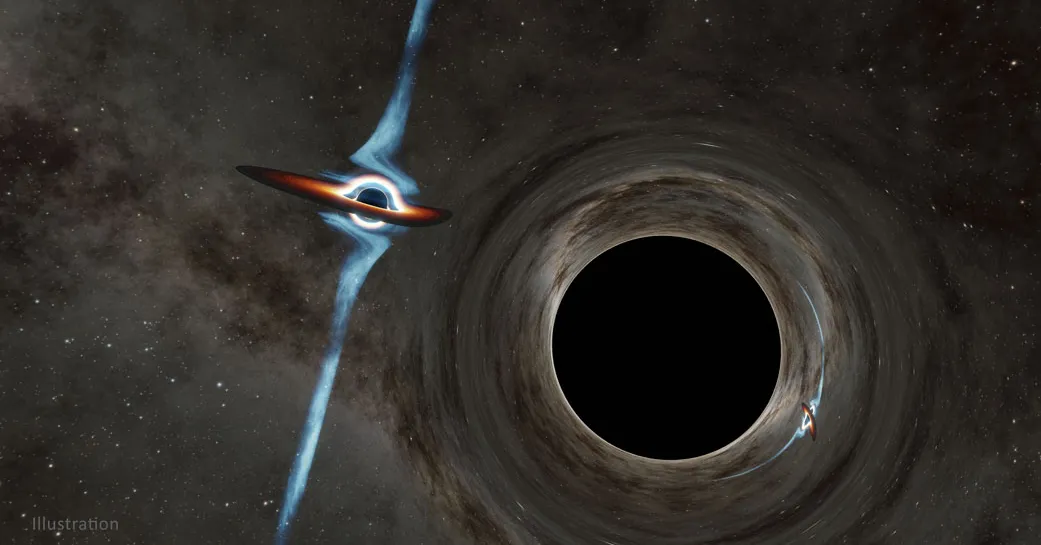
An international team of astrophysicists has published evidence in Nature Astronomy identifying the origin of intermediate-mass black holes, objects with masses between 40 and 100 times that of the sun. The study concludes that these entities are formed through the merging of smaller black holes rather than the collapse of a single massive star, resolving a long-standing discrepancy in astrophysical models.
Conventional stellar physics posits that black holes formed from the collapse of massive stars typically have masses between 10 and 40 solar masses. Supermassive black holes, found at the centres of galaxies, contain millions or billions of solar masses. This left the intermediate range unexplained under standard models, leading scientists to classify these objects as "impossible" because they are too heavy to be born from stellar collapse but too small to be supermassive.
The findings are based on an analysis of a transient catalog of gravitational waves recorded by three leading observatories. The database included 153 reliable detections of black hole mergers, with 34 corresponding to particularly heavy objects. Gravitational wave detectors, which measure micro-distortions in space-time caused by the collision of dense objects, have enabled these observations since the first detection in 2015.
By comparing the signals, the team identified two distinct populations. Lighter black holes, up to about 40 solar masses, exhibited small, aligned spins consistent with objects born from stellar collapse. However, from approximately 45 solar masses onwards, a different population emerged: heavier black holes with rapid, chaotic spins. This statistical signature indicates that these objects are "second-generation" entities resulting from previous collisions.
Isobel M. Romero-Shaw, a coauthor of the research from Cardiff University, stated that the observed spin patterns are the exact signature expected if black holes repeatedly merged in dense stellar clusters. The study suggests that the heaviest black holes are "built rather than born," arising from previous generations of collisions in the densest environments in the cosmos.
While researchers have not directly observed these intermediate-mass black holes in x-rays or the visible spectrum, their collisions vibrate space-time in ways that reveal masses stellar physics cannot otherwise explain. The evidence confirms that the universe recycles black holes, merging them to form even larger structures in dense stellar clusters.
This story originally appeared in WIRED en Español and has been translated from Spanish.
