Euro Area Economic Sentiment Drops to 93 Amid Consumer Weakness
Consumer confidence plummets to lowest level since late 2022 as services and manufacturing sectors struggle; ECB warns of external shocks complicating policy
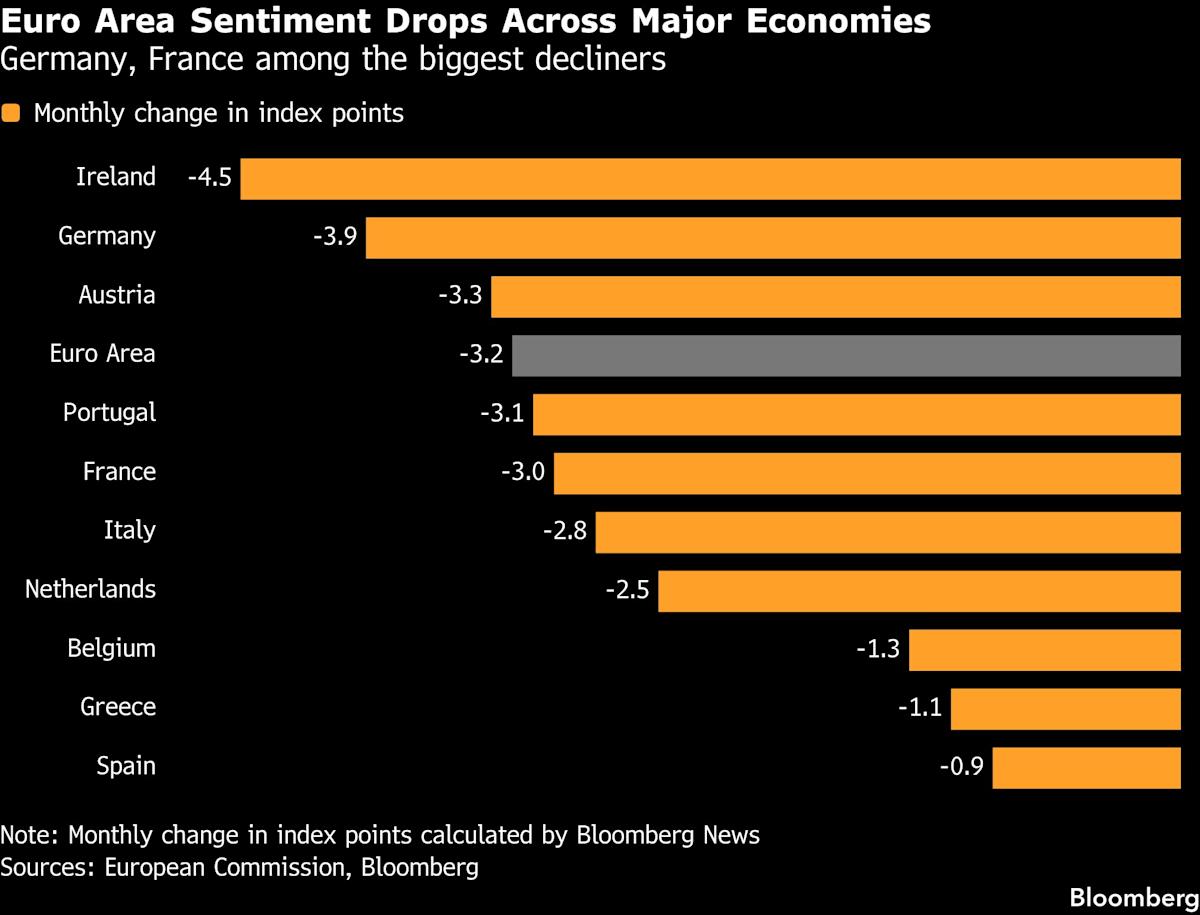
Euro area economic sentiment has deteriorated for a third consecutive month, falling to 93 in April from 96.2 in March. The latest data released by the European Commission on Wednesday indicates a broad weakening of mood across the region, with the economic uncertainty indicator rising to 23.6 to reflect heightened anxiety about future conditions.
The decline was driven primarily by a sharp contraction in consumer confidence, which plummeted to -20.6 from -16.4 in March. This figure marks the lowest level recorded since December 2022, suggesting that household sentiment has reached a critical low point. The services sector also suffered a significant blow, with sentiment dropping to 0.9 from 4.1, while manufacturing confidence edged lower to -7.7 from -7.0.
European Central Bank President Christine Lagarde addressed the implications of these figures last week, noting that disruptions stemming from the war in the Middle East are complicating the central bank's mandate. She highlighted that potential spillovers from energy prices are adding to the complexity of the situation, stating that the current environment requires more information before the ECB can draw firm conclusions for its monetary policy.
With the headline sentiment figure dropping, the focus now turns to upcoming data releases scheduled for Thursday. Markets will await the publication of Euro-area first-quarter GDP, preliminary inflation data, and the ECB's interest rate decision. These figures are expected to provide a clearer picture of the region's economic trajectory in the wake of the recent downturn in sentiment.
The broader context of global tensions continues to influence investor sentiment within the Eurozone. While the European Commission data provides a snapshot of current conditions, the fluid nature of external threats means that policy responses remain cautious. Investors are watching closely to see how the central bank balances the need for stability against the uncertainty of ongoing geopolitical events.