Edward Jones posts 25% profit jump as net new assets hit $17.7 billion
St Louis-based firm reports strong client inflows and asset appreciation in Q2 2026, while providing further details on its upcoming partnership restructuring.
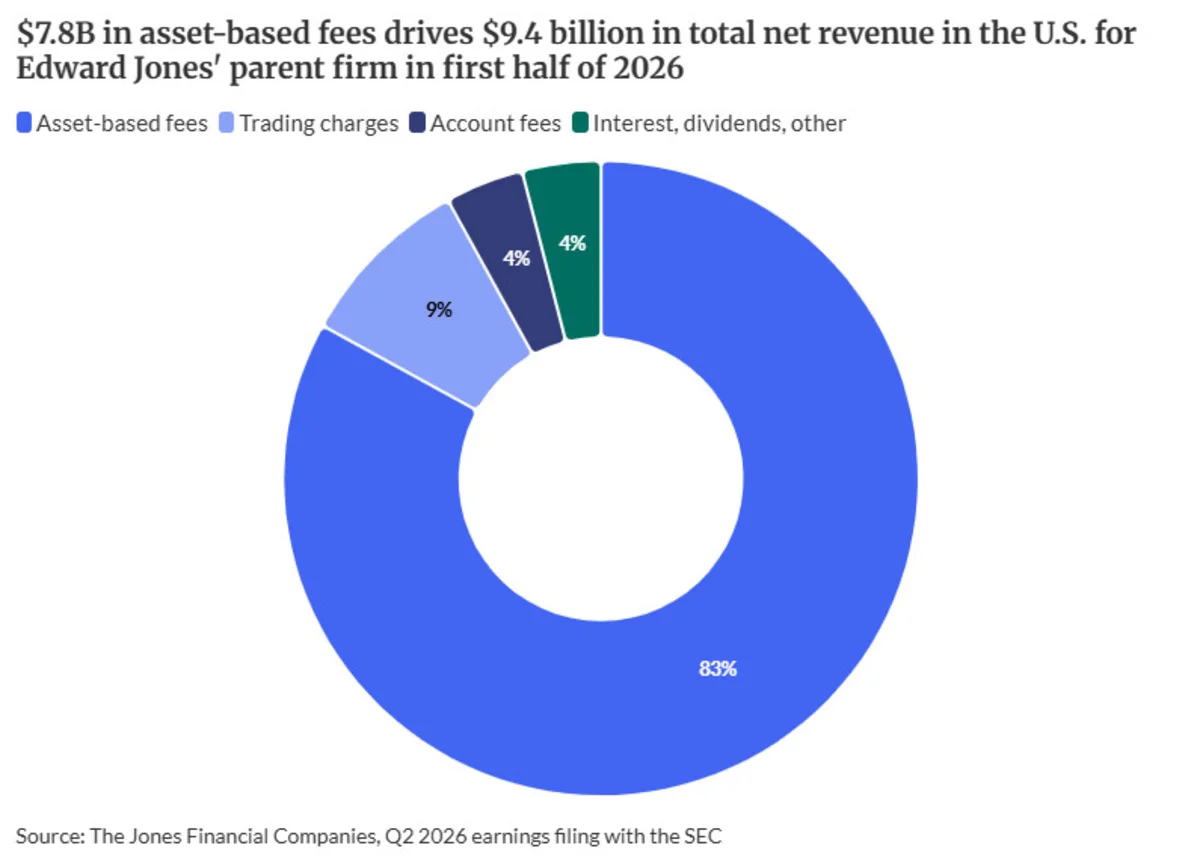
Edward Jones, the St Louis-based wealth management firm, reported a 25 per cent increase in second-quarter 2026 profits, driven by a combination of robust client inflows and asset appreciation. The firm’s parent company recorded $588 million in income before partner allocations on net revenue of $4.9 billion, marking an 18 per cent rise in revenue and a 0.8 percentage point improvement in operating margin compared to the same period last year.
The growth was underpinned by significant client activity, with net new assets climbing 8 per cent year-on-year to $17.7 billion. Total client assets under care surged 15 per cent to $2.6 trillion, while the number of client households grew by 2 per cent to 6.1 million. These metrics helped the firm offset higher operating expenses, which rose 17 per cent to $4.3 billion.
A substantial portion of the cost increase was attributed to advisor compensation, which jumped 18 per cent to $1.9 billion. Variable compensation, which is tied to asset values, soared by a third year-on-year to $763 million. The firm also increased spending on technology, citing higher depreciation and communications costs due to investments in new tools and data processing capabilities.
On the personnel front, Edward Jones added 212 financial advisors in the quarter, bringing its total U.S. advisor count to 19,647. This represents a 1 per cent increase from the previous year, defying recent industry trends of rising attrition. The expansion in staff and client base contributed to the firm’s ability to maintain profitability despite the elevated cost structure.
The firm also provided further details on a planned exchange of Class A limited partnership stakes for new Class B shares, expected to be issued on 4 January 2027. Up to 33,079 Class A limited partners may be eligible for the new shares. While Class B partners will forfeit the guaranteed 7.5 per cent returns received by Class A holders, the company states the move aims to simplify the partnership structure, reduce expenses, and improve credit standing.
Interest rate sensitivity remains a key factor for the business. Excluding assets in its money market fund and at third-party banks, the firm noted that a 1 per cent hike to short-term rates could boost its parent company’s annual net interest income by $120 million. Conversely, a 1 per cent cut could reduce that income by $147 million.