Decart launches Oasis 3 world model for autonomous vehicle simulation
The two-year-old firm, valued at nearly $4 billion, leverages proprietary optimisation stack to undercut rivals on compute costs, though technical challenges with physics and consistency remain.
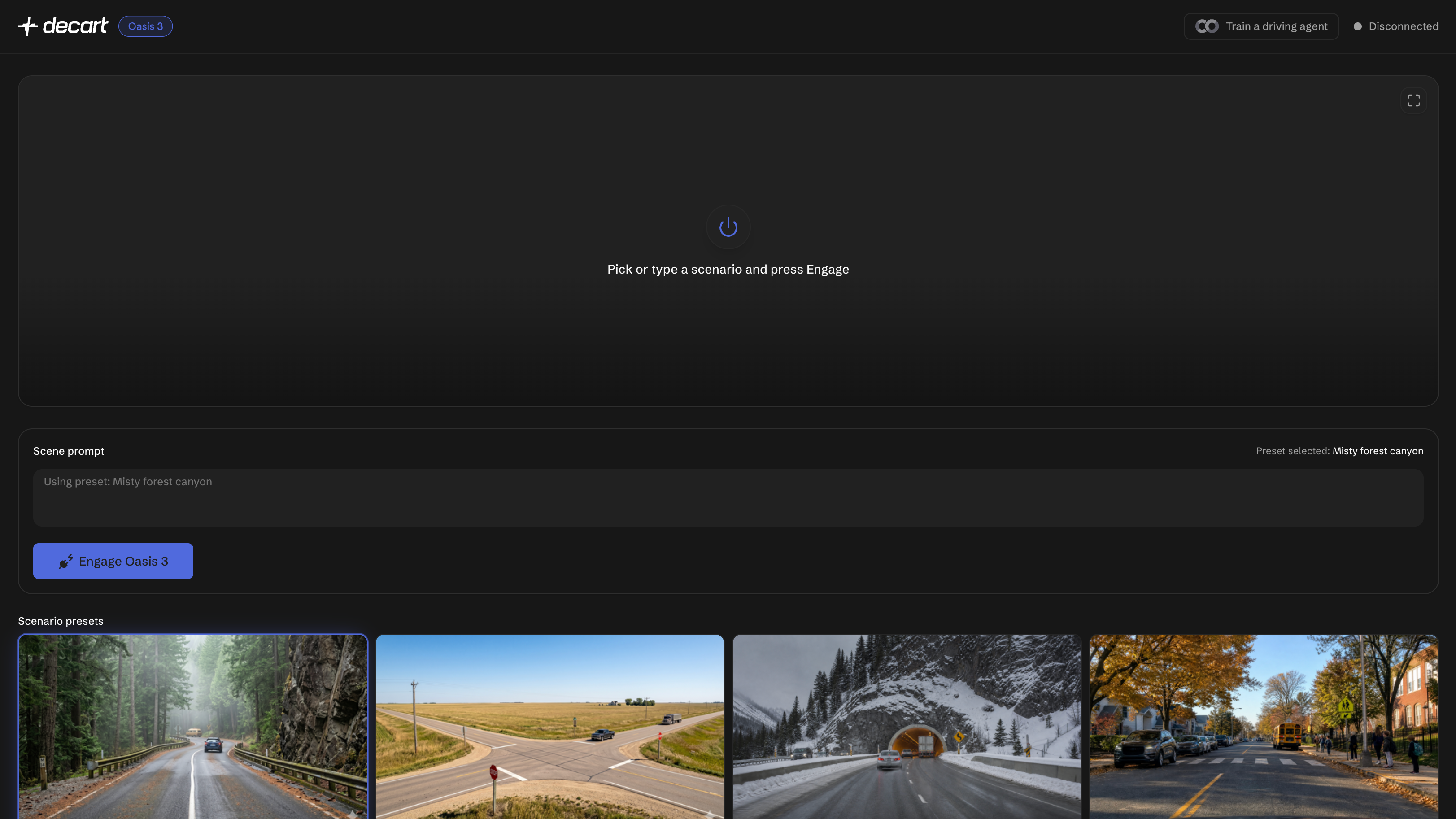
AI startup Decart has unveiled Oasis 3, a real-time world model designed to generate photorealistic driving environments for autonomous vehicle testing. Available via API, the model targets developers and AV companies, leveraging Decart’s optimization stack to offer lower costs than competitors. While praised for its visual fidelity and infinite generation capabilities, the model currently faces challenges with long-term consistency, physics simulation, and control responsiveness.
The launch positions Decart to capture a share of the rapidly expanding world model arena, which includes competitors such as Google with Genie 3, World Labs with Marble, and video generation firms Luma and Runway. CEO Dean Leitersdorf compares the strategy to OpenAI’s early API approach, predicting a surge in developer-built applications within three months. The startup aims to build a developer ecosystem around the model, leveraging its existing community of over 100,000 developers.
Oasis 3 is priced at $0.02 per second, with enterprise pricing dependent on specific use cases. The model utilises Decart’s DOS (Decart Optimization Stack) software to run efficiently on Nvidia, Amazon, and Google hardware. Decart claims this vertical integration makes it more than an order of magnitude cheaper to run than competitors, with lifetime compute costs reportedly under $100 million.
Built on Decart’s existing real-time video model, Lucy, Oasis 3 generates physically accurate, multi-camera environments consisting of one front-facing and two side-facing views. It is auto-regressive, generating one frame at a time based on previous outputs, with each frame consisting of roughly 8,000 tokens. This architecture allows for infinite generation of scenarios, intended to help AV developers test rare edge cases.
Despite its efficiency, the model faces industry-standard hurdles. Testing reveals issues with long-term consistency, where thematic integrity degrades rapidly over time, and physics simulation, with vehicles occasionally driving through obstacles. These challenges are attributed to a data imbalance where there is significantly more data on normal driving than on accidents or collisions.
Decart’s valuation has surged to nearly $4 billion following a recent $300 million raise. Investors include Toyota, Adobe, eBay, and Nvidia, all of whom represent potential customers for the new simulation tool. The company’s background in e-commerce and live streaming via the Lucy model provides a foundation for this push into physical AI applications.
