Chinese humanoid robots outpace Usain Bolt’s 100-metre record at Beijing games
Tiangong Ultra and Honor’s Lightning have set new benchmarks in bipedal robotics, surpassing human world records in sprinting events at the World Humanoid Robot Games.
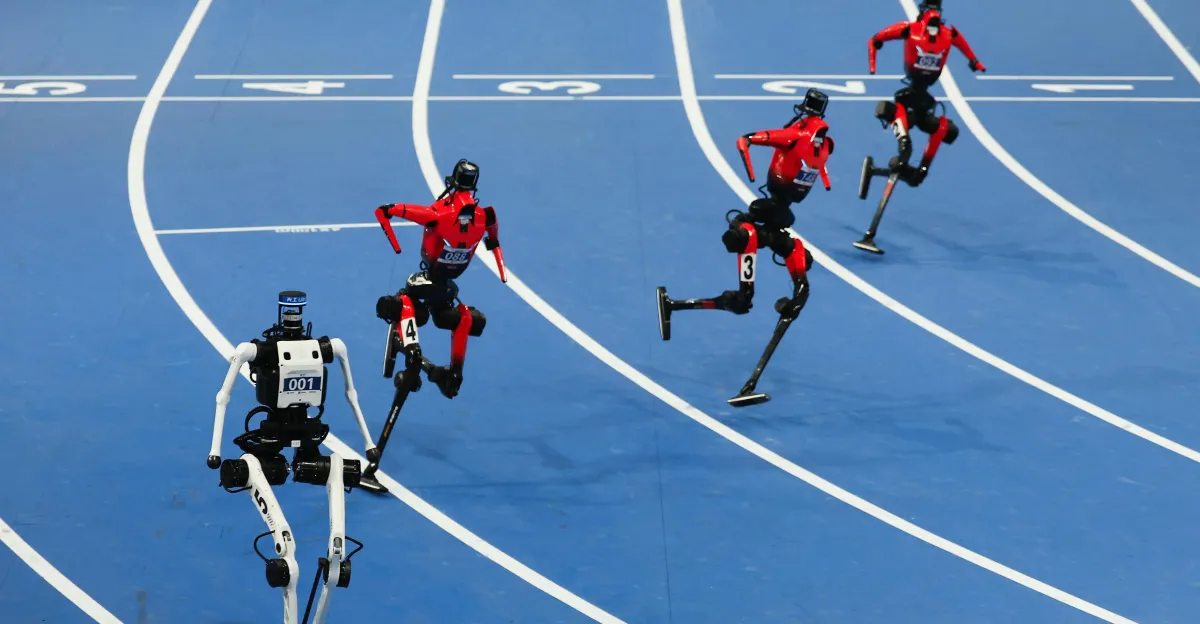
The 9.58-second 100-metre dash record set by Usain Bolt in 2009 has been outpaced by Chinese humanoid robots competing at the World Humanoid Robot Games in Beijing. In a preliminary heat on Saturday, Tiangong Ultra, developed by the Beijing Humanoid Robot Innovation Center, completed the distance in 9.39 seconds. The Honor-developed Lightning followed closely behind, finishing the sprint in 9.47 seconds.
These results mark a significant milestone for bipedal bot technology, as the machines have now surpassed established human athletic benchmarks. Tiangong Ultra also demonstrated its speed in the 400-metre race, recording a time of 38.16 seconds. This performance beat the 43.03-second world record set by Wayde van Niekerk in 2016, further highlighting the rapid advancement of mechanical sprinting capabilities.
The World Humanoid Robot Games, described as an annual robot Olympics, launched in 2025 to showcase progress in the sector. This year’s edition features 2,056 robots from 16 countries competing in various athletic categories, including sprinting, jumping, football, and boxing. The event serves as a key indicator of the maturation of humanoid robotics for both commercial and industrial applications.
However, the transition from raw speed to controlled movement remains a challenge for the machines. Unlike human athletes, the sprinting bots do not typically perform a victory lap after crossing the finish line. Due to an inability to stop effectively, several videos show the robots colliding into cushioned walls or crash pads at impressive speeds.
The aftermath of these high-speed sprints often involves the robots, or the pieces of what is left of them, being collected and carried away on a stretcher. Observers have noted that watching the various robot models run is both amusing and slightly unsettling, given the bizarre manner in which they move to achieve such rapid times.
While the preliminary heats have produced record-breaking times, the final championship results may yet to be determined. Nevertheless, the performance of Tiangong Ultra and Lightning suggests that humanoid robots are becoming increasingly competitive in athletic disciplines that were previously exclusive to biological athletes.