China’s space debris burden doubles as launch ambitions outpace disposal norms
Space domain awareness expert Jim Shell warns that China’s rapid ascent to the world’s second-most productive space power is generating a significant accumulation of uncontrolled orbital debris, a trend analysts say will worsen without adherence to established disposal practices.
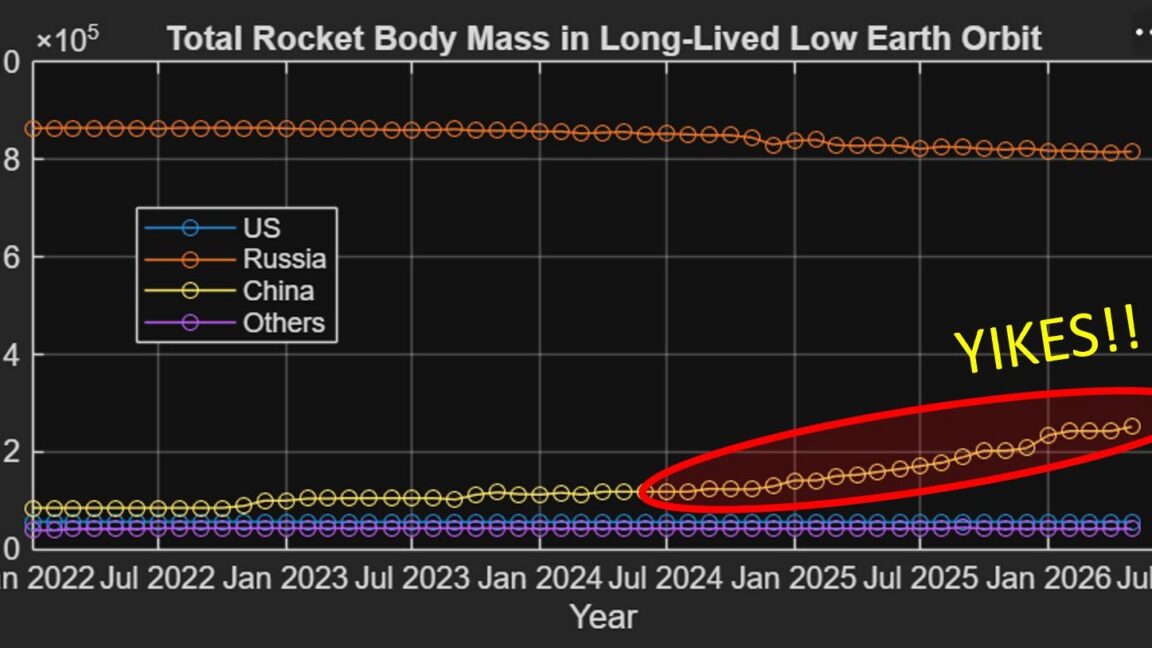
China has cemented its position as the second-most productive space power in the world, launching 93 rockets last year after a record-breaking 64 in 2022. This surge, driven by both state-owned enterprises and a growing number of private launch companies, has placed the nation on a trajectory to potentially launch more than 1,000 rockets over the next decade. However, this rapid expansion is accompanied by a sharp increase in orbital debris, specifically from spent rocket upper stages that are being abandoned in long-lived orbits rather than being disposed of responsibly.
According to a new analysis by space domain awareness expert Jim Shell, the mass of Chinese rocket bodies in long-lived orbits has more than doubled in the past five years, rising from under 100 metric tons to 252 metric tons. Shell, who highlighted the issue on LinkedIn, noted that while the Soviet Union and later Russia hold the largest total mass of such debris at approximately 800 metric tons, their figures are slowly declining as stages naturally decay. In contrast, the United States maintains a steady figure of about 57 metric tons, whereas China’s accumulation is growing rapidly due to its intensified launch cadence.
The primary driver of this debris growth is China’s push to deploy satellite megaconstellations, including Guowang and Spacesail, designed to compete with SpaceX’s Starlink service. These constellations typically operate at altitudes above 800 kilometres, requiring launches that leave upper stages in high low-Earth orbit. Unlike operational satellites, which are smaller and can be manoeuvred to avoid collisions, these spent stages are uncontrolled metal masses that cannot be steered. Consequently, they are rated by experts as the most concerning type of space debris due to their persistence and collision risk.
Shell emphasised that abandoning rocket bodies in high orbits contravenes long-established best practices acknowledged by major space-faring nations. Modern disposal protocols typically involve reserving propellant for a final burn to de-orbit stages into remote oceanic locations, such as Point Nemo, or placing them in heliocentric orbits for higher-altitude launches. The failure to adopt these measures means that the current growth in Chinese upper stages is likely to persist, exacerbating congestion in an already crowded space environment.
While China’s launch growth mirrors the expansion seen in the United States, the divergence in debris management standards presents a distinct sustainability challenge. With the country’s space industry just beginning its megaconstellation deployments, analysts warn that without a shift toward responsible disposal, the volume of uncontrolled debris will continue to rise, posing increasing risks to the long-term viability of low-Earth orbit operations.
