Camp Miasma: The Fictional Horror Franchise Built to Trick the Eye
From fully playable board games to chronologically accurate lunch boxes, the team behind Teenage Sex and Death at Camp Miasma prioritised emotional resonance over exact replication to evoke fragmented childhood memories.
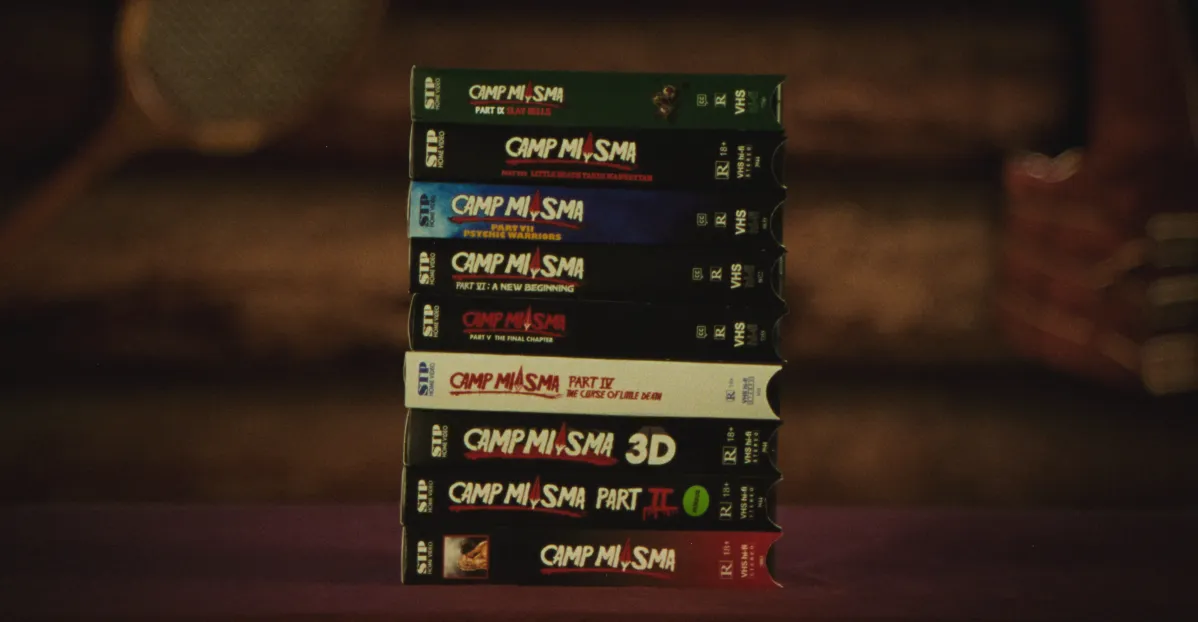
Jane Schoenbrun’s latest film, Teenage Sex and Death at Camp Miasma, arrives in theatres on August 7, bringing with it a fictional horror franchise that feels disturbingly real. Starring Hannah Einbinder and Gillian Anderson, the narrative follows a budding director attempting to reboot the dormant Camp Miasma series by recruiting the original film’s final girl, who has lived in isolation for decades. To establish the authenticity of this non-existent property, production designers Matt Hyland and Brandon Tonner-Connolly undertook an extensive campaign of prop creation that spanned decades of imagined media history.
The film opens by rapidly chronicling the rise and fall of the Camp Miasma franchise through a montage of physical objects. Viewers are presented with old movie posters, VHS tapes, toys, photographs, and even film reviews that trace the series’ trajectory from box office success to direct-to-video decline over approximately 30 years. This visual shorthand serves as a powerful narrative tool, grounding the story in a tangible past before the plot shifts to the intimate journey between Einbinder’s character and Anderson’s isolated survivor.
Creating this illusion required rigorous research into the aesthetics of real-world slasher series, including Friday the 13th, Sleepaway Camp, A Nightmare on Elm Street, and Halloween. The design team constructed a historical document outlining the fictional franchise’s existence, detailing release dates, directorial credits, and merchandise lines. They then collaborated closely with Schoenbrun and the cinematographer to map out the title sequence beat by beat, ensuring every fleeting object on screen was fully realised.
The commitment to detail extended to items that appeared for only seconds. The production designers created a fully playable board game complete with instructions, and ensured that VHS boxes and posters included plausible production and distribution company credits. Hyland noted that decisions could not be based on screentime, explaining that the team treated every prop as a complete artefact. This approach was driven by the expectation that the film’s dedicated audience would pause to inspect these details, requiring a level of consistency that would withstand close scrutiny.
Chronological accuracy was paramount in the merchandise design. The team produced multiple versions of items such as lunch boxes, ensuring the designs reflected the stylistic shifts between 1983 and 1997. However, the goal was not to perfectly replicate existing designs, but to capture the feeling of remembering them. Drawing on the approach used in Schoenbrun’s previous film, I Saw the TV Glow, the designers aimed to evoke the fragmented, often misremembered nature of childhood media consumption, similar to the nostalgic tone of Buffy the Vampire Slayer.
By prioritising emotional resonance and the memory of watching over exact replication, the production team created a world that feels lived-in and authentic. This meticulous attention to detail allows the film to convince audiences that Camp Miasma has been part of the cultural conversation for decades, providing a grounded foundation for the story’s more fantastical turns. The result is a cinematic experience where the boundary between fiction and reality is deliberately blurred, inviting viewers to question what is real and what is merely a memory.
