Bond markets price in rate hikes as Warsh takes Fed helm
Two-year yields hit 4.14% as investors bet incoming Chair Kevin Warsh will prioritise inflation control over political pressure for lower borrowing costs.
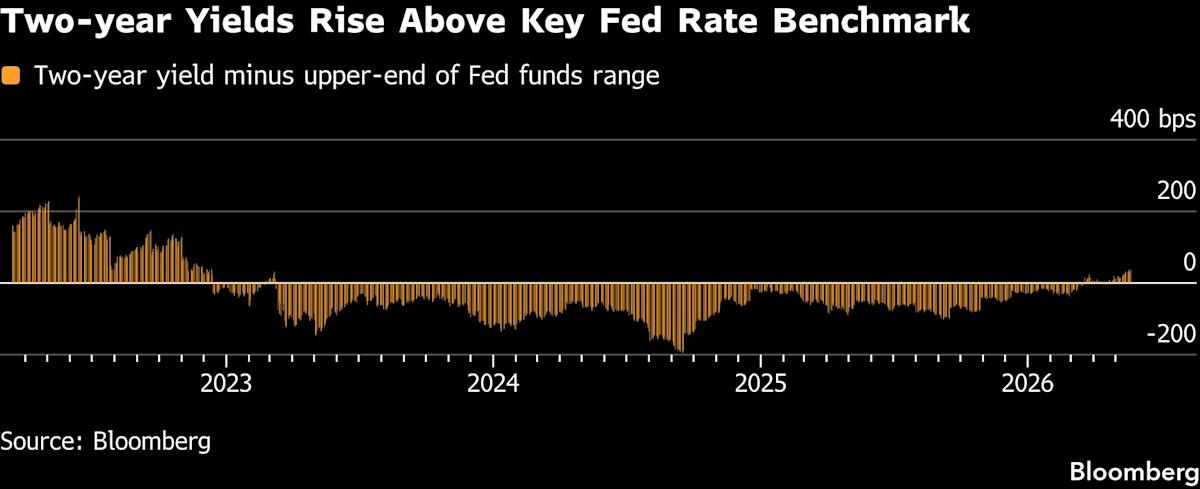
Bond investors are now pricing in a Federal Reserve interest rate hike by December 2026, marking a decisive shift in market expectations as Kevin Warsh assumes the role of central bank chair. Traders are betting that Warsh will prioritise the institution’s inflation-fighting credibility over President Donald Trump’s repeated calls for lower borrowing costs. This reversal follows a period just three months ago when markets were forecasting deeper rate cuts, driven instead by a combination of Middle East conflict-induced inflation, a resilient US economy, and an artificial intelligence investment boom.
The market’s recalibration has pushed yields to significant levels, with two-year Treasury yields climbing to 4.14% on Friday, the highest in more than a year. This figure sits nearly 40 basis points above the top end of the Fed’s current benchmark rate range. Meanwhile, 30-year yields briefly touched 5.2% last week, a level not seen since 2007, before retreating to 5.06%. The surge reflects growing concerns that inflation, described as the biggest surge since 2023 following turmoil in the Middle East, could remain entrenched above the Fed’s 2% target for an extended period.
Policy signals from within the central bank have reinforced the hawkish turn. Governor Christopher Waller, a Trump appointee who previously advocated for rate cuts to protect the labour market, stated on Friday that the Fed’s next move is now just as likely to be a hike as a cut. This comment signals a clear departure from the easing bias that characterised recent months. A slate of policymakers, including Vice Chair Philip Jefferson and New York Fed President John Williams, are scheduled to speak this week, adding to the scrutiny on the Fed’s evolving stance.
Despite the aggressive pricing of hikes, some investors remain cautious about the speed of policy tightening. Chitrang Purani, a portfolio manager at Capital Group, expressed a bullish view on short-term Treasuries, noting that the bar for hiking rates remains high. Purani suggested that Warsh may exercise patience to fully understand how inflation is translating into labour markets and financial conditions, arguing that the Fed’s reaction function to economic data may not differ materially from past administrations.
Market participants are now turning their attention to upcoming Treasury auctions for two-, five-, and seven-year notes to gauge investor demand, alongside a dense schedule of economic data releases in late May. As Warsh was sworn into office, Trump stated he wants the new chair to lead the central bank independently, even as the bond market adjusts to the reality that inflation control is likely to take precedence over political preferences for cheaper credit.