Berkshire’s Abel Sells Amazon Stake, But Analysts Point to Cloud and AI Strength
The Motley Fool argues that Amazon’s accelerating cloud growth and expanding artificial intelligence capabilities make the stock attractive despite the sale by Berkshire Hathaway’s vice chairman.

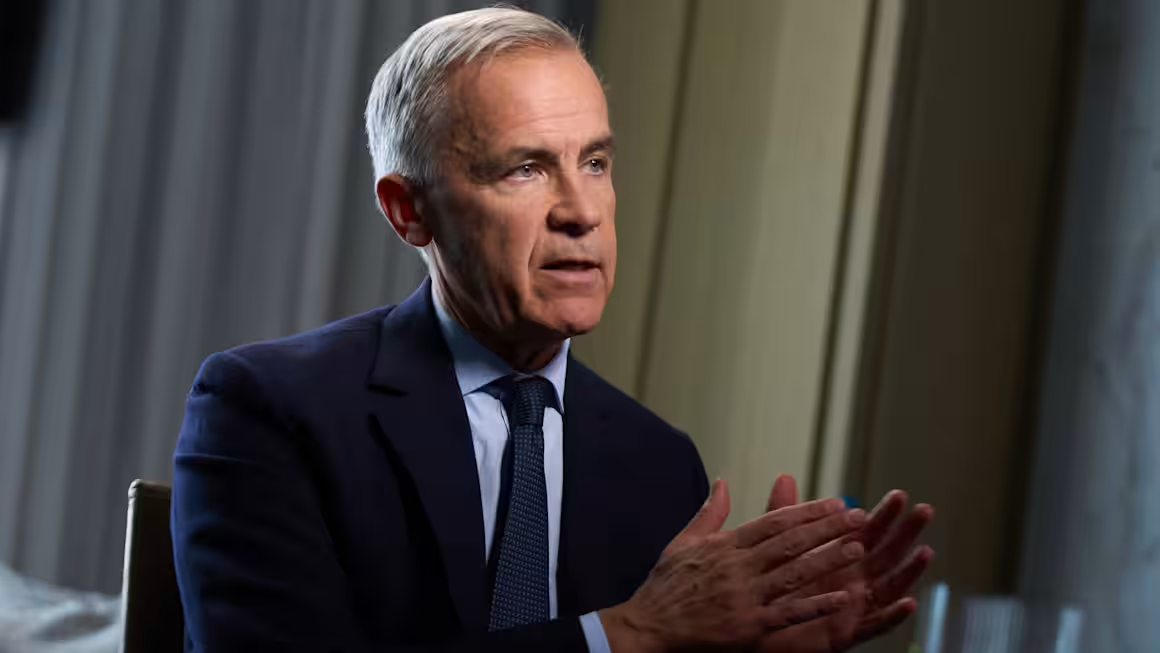
Greg Abel, vice chairman of Berkshire Hathaway, has sold his stake in Amazon shares, realising a 131% gain on the position originally purchased in 2019. The transaction, completed in the first quarter of 2026, has drawn attention from market observers, but an analysis by The Motley Fool suggests the sale does not constitute a warning for retail investors. The publication argues that Berkshire’s investment goals differ significantly from those of individual shareholders, citing the conglomerate’s complex structure and insurance operations as factors that do not necessarily reflect the stock’s underlying value for long-term holders.
Amazon’s performance in the first quarter of 2026 highlights robust fundamentals, particularly within its cloud computing and artificial intelligence divisions. Amazon Web Services (AWS) sales growth accelerated to 28% year-on-year, marking the highest growth rate in 15 quarters. This expansion is driven by a broader shift of enterprise spending from on-premises infrastructure to the cloud, with major new deals secured in the quarter involving Bloomberg, the U.S. Army, Meta Platforms, and Nvidia. The acceleration adds $2 billion in revenue compared to the previous quarter, underscoring the scale of AWS’s market position.
The company’s artificial intelligence capabilities are also contributing significantly to its growth trajectory. Amazon’s AI semiconductor business, which includes the Trainium and Graviton chip lines, reported a 40% quarter-over-quarter sales increase in the first quarter. If treated as a standalone entity, this segment would represent a $50 billion run rate, positioning it among the largest chip companies globally. The Trainium4 chip is already in development with all phases sold out, while the Graviton CPUs continue to see high demand for agentic AI workloads due to their cost efficiency and performance.
Beyond technology, Amazon’s core e-commerce business remains a dominant force, accounting for the bulk of the company’s sales. The retail arm continues to expand its delivery capabilities, now servicing 2,300 metro cities with three-hour delivery and hundreds of cities with one-hour delivery on 90,000 products. The company added 600 new brands in the first quarter and has become the second-largest grocer in the United States, a position that drives higher overall basket sizes for customers. E-commerce growth remains in double-digit territory despite the company’s massive size.
Amazon is also advancing its broadband satellite business, Amazon Leo, which aims to compete with SpaceX’s Starlink. The project has already launched 10 satellites, with more than 250 low-Earth orbit satellites currently in space, and plans to launch 20 more next year. Early partnerships include agreements with Delta Air Lines and Apple. With the stock trading at a price-to-earnings ratio of 32, analysts at The Motley Fool view the valuation as attractive given the company’s diversified opportunities in cloud, AI, and retail, suggesting that Abel’s sale should not deter investors from considering the stock.