Bengals face roster calculus as Cedric Johnson’s camp efficiency challenges draft pedigree
Cedric Johnson’s 23 pressures from 197 attempts have intensified competition at a crowded defensive line position, complicating the return timeline for Shemar Stewart.
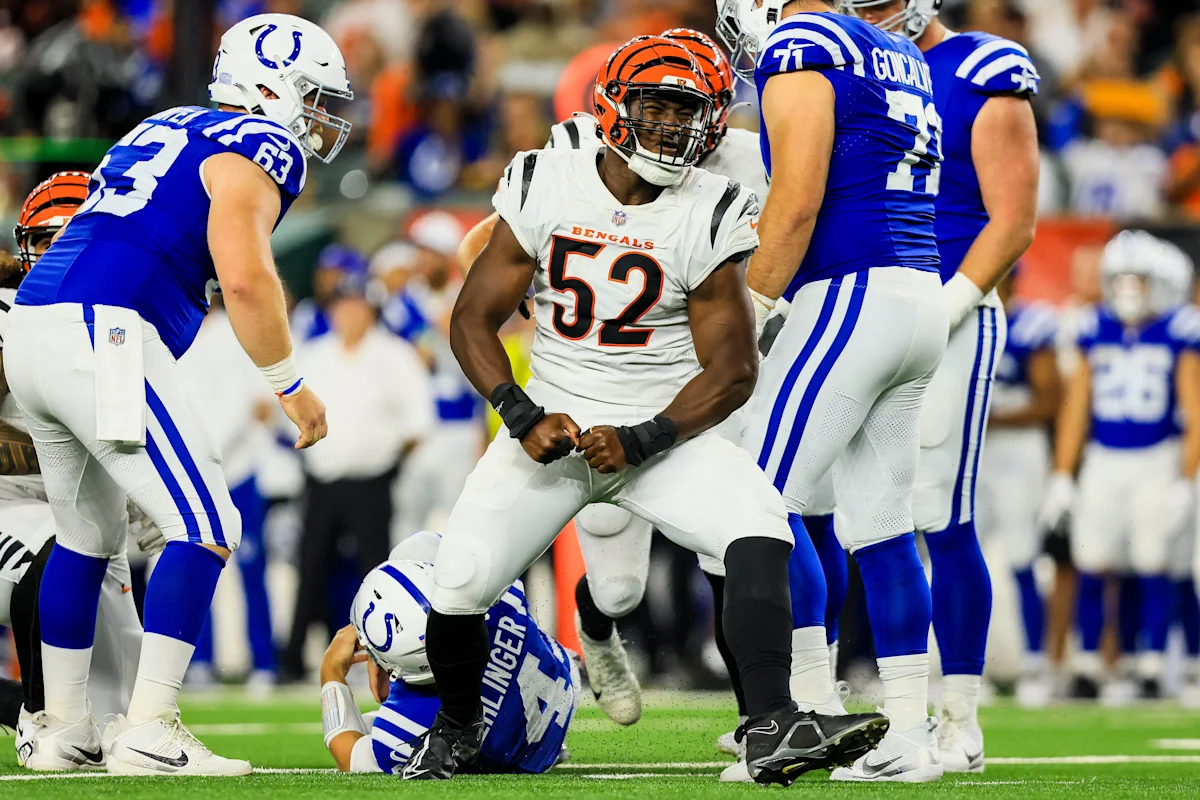
The Cincinnati Bengals’ coaching staff is confronting a strategic dilemma regarding the composition of their defensive line as training camp progresses. Defensive end Cedric Johnson has emerged as a high-efficiency performer, recording 23 pressures from 197 pass-rush attempts. This statistical output has disrupted the anticipated rotation at a position group that was initially viewed as settled, forcing a re-evaluation of playing time distribution among the squad’s depth options.
The team’s pre-camp structural plan for the defensive end position centred on a platoon involving Boye Mafe, Cashius Howell, and Myles Murphy, with first-round pick Shemar Stewart expected to integrate into that rotation. However, Stewart’s current absence due to injury has opened a vacancy that Johnson has exploited. According to analysis by The Athletic’s Paul Dehner Jr., Johnson has been identified as one of the most significant beneficiaries of the camp’s current dynamics, outperforming the initial depth chart projections.
The core of the administrative challenge lies in balancing Johnson’s current productivity against the developmental mandate for Stewart. While Johnson’s sample size is small, his efficiency suggests he provides immediate value to a defence that requires enhanced pass-rushing capabilities. The coaching staff must now determine whether to maintain Johnson’s elevated workload to capitalise on his current form or to sideline him temporarily to ensure Stewart receives adequate developmental snaps upon his return from injury.
This decision carries implications for the team’s depth chart management heading into the 2026 season. The presence of multiple viable candidates at the defensive end position, including Johnson, Stewart, Mafe, Howell, and Murphy, indicates a shift from viewing the group as a weakness to potentially leveraging it as a strength. The ability to share snaps effectively could contribute to player freshness and injury mitigation, provided the coaching staff can resolve the hierarchy of roles.
Johnson, selected in the sixth round of the 2024 draft, has demonstrated untapped potential that complicates the traditional preference for higher draft capital. The uncertainty surrounding the duration of Stewart’s injury further obscures the timeline for any roster adjustments. Ultimately, the Bengals must decide whether to institutionalise Johnson’s role based on current performance metrics or to prioritise the long-term development of their first-round selection.