Bank of America warns Salesforce core growth lags AI hype
Salesforce reported record fiscal first-quarter results, yet Bank of America analyst Tal Liani argues that slow organic expansion and a potential shift away from seat-based pricing warrant a $160 price target.
Bank of America analyst Tal Liani has reiterated an Underperform rating on Salesforce, maintaining a $160 price target despite the enterprise software giant reporting record fiscal first-quarter results. The analyst’s caution stems from concerns that the company’s core business growth remains insufficient to justify a higher valuation multiple, even as artificial intelligence-related revenue figures surge.
Salesforce reported revenue of $11.1 billion for the quarter ended April 30, representing a 13 per cent increase from a year earlier and a 12 per cent rise in constant currency. GAAP diluted earnings per share jumped 52 per cent to $2.42, while non-GAAP diluted earnings rose 50 per cent to $3.88. The company also reported current remaining performance obligations of $33.6 billion, up 14 per cent year-on-year.
However, the bank’s analysis focused on the underlying quality of that growth. Excluding the impact of Informatica, organic revenue grew only 7.1 per cent in constant currency. Liani described the quarter as largely uninspiring, noting that current remaining performance obligations growth of 13 per cent in constant currency was in line with Wall Street expectations rather than exceeding them.
The most significant concern for the bank lies in the trajectory of Agentforce Apps, which represent approximately 65 per cent of Salesforce’s revenue. These products showed negligible sequential growth of just 0.3 per cent, posting between zero and two per cent growth over the past three quarters. Softness was also noted in Commerce and Tableau, areas that are critical to the company’s broader ecosystem.
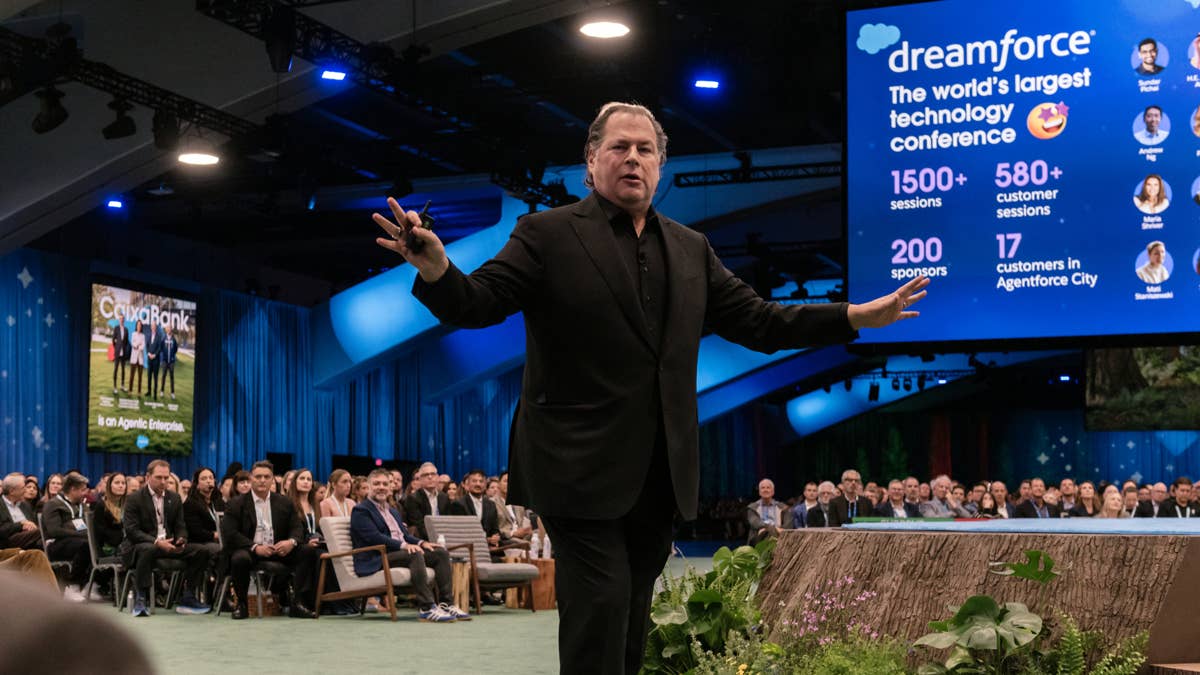
Salesforce’s AI strategy remains its primary counterargument, with Chair and CEO Marc Benioff describing agentic AI as the company’s biggest growth opportunity. Products such as Agentforce and Data 360 generated nearly $3.4 billion in annual recurring revenue, with Agentforce ARR alone surging 205 per cent to $1.2 billion. The company delivered 3.8 billion Agentic Work Units across Agentforce and Slack, a figure that grew 111 per cent quarter-on-quarter.
Despite these AI gains, Liani warned that the shift towards agentic AI could pressure Salesforce’s traditional seat-based monetisation model, which has historically driven expansion. The bank noted that early adoption has been supported by Flex offerings, but the mature parts of the business are moving too slowly to offset the transition.
Salesforce’s non-GAAP operating margin came in at 34.8 per cent, beating analyst estimates by 140 basis points, largely due to expense timing. Nevertheless, the bank’s valuation reflects its caution, applying a multiple of nine times its calendar 2027 enterprise value to free cash flow estimate. This sits near the low end of the software peer average range of eight to 14 times.
Liani concluded that investors require clearer evidence that AI gains can restart core growth before the stock warrants a higher valuation multiple. The $160 price target implies approximately 9.9 per cent downside from the $177.51 share price listed in the note.