Audi confirms 499-unit production run for Nuvolari hybrid supercar
The automaker unveiled the Nuvolari concept in the South of France, promising 987 hp and a 2.6-second 0-100 km/h time as it replaces the R8 lineage.
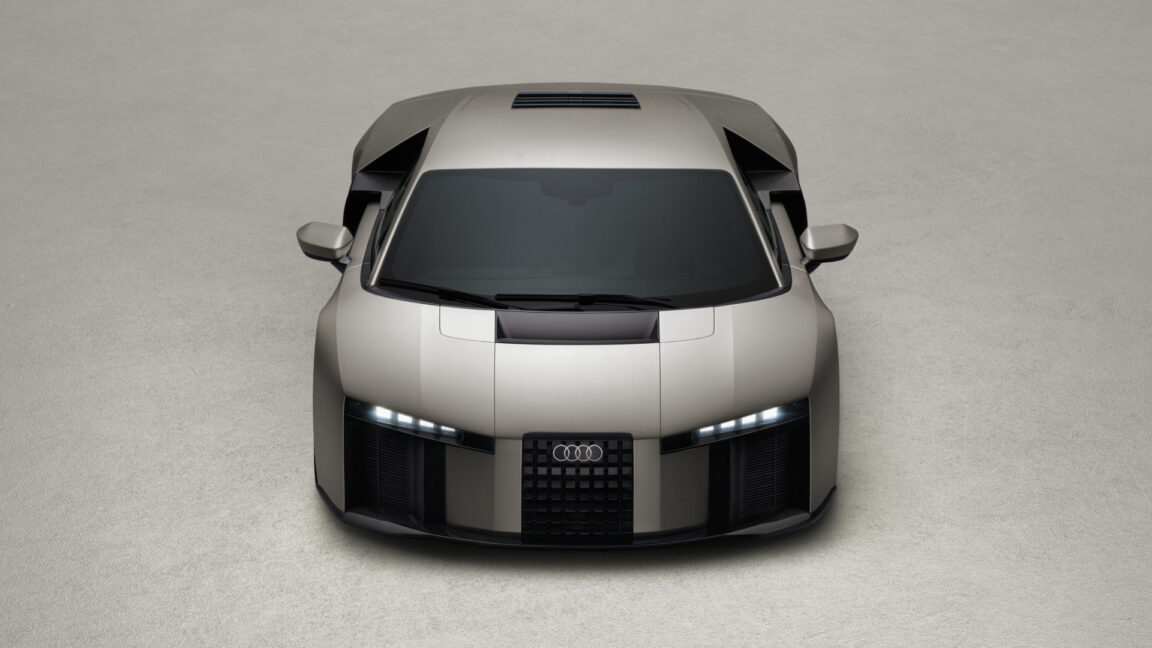
Audi has officially unveiled the Nuvolari concept in the South of France on the eve of the Monaco Grand Prix, confirming the vehicle will enter production in the first half of next year. The automaker committed to building 499 units of the mid-engined plug-in hybrid supercar, a model that signals a significant departure from its current design language while utilising the platform of its Volkswagen Group sibling, Lamborghini.
The Nuvolari leverages the Temerario platform, which replaced the Huracán and ended the era of the naturally aspirated V10 engine that historically powered previous generations of the Audi R8. The new powertrain combines a 788 hp turbocharged V8, which revs to 10,000 rpm, with three 148 hp axial flux electric motors. This configuration delivers a total output of 987 hp, enabling a 0-100 km/h sprint in 2.6 seconds and a top speed exceeding 350 km/h.
Audi CEO Gernot Döllner previously indicated the company was developing a successor to the R8, and the Nuvolari’s styling aligns more closely with the Concept C coupe than its current lineup. The bodywork is constructed from carbon fibre, marking the first time the manufacturer has used this material for a production car body. The lithium-ion battery has a gross capacity of 7.3 kWh, though usable capacity may be limited to approximately half during driving.
The development process incorporated targeted feedback from Audi’s Formula 1 drivers, particularly regarding aerodynamics. The vehicle features high- and low-downforce settings for its active rear wing. While Audi describes the braking system as F1-derived, it utilises carbon-ceramic disks rather than the carbon-carbon type found in racing, which would be unsuitable for road use.
Performance figures place the Nuvolari on par with the Bugatti Veyron in terms of power output, though it is not expected to rival the Veyron’s top speed. The Temerario, which serves as the Nuvolari’s mechanical base, was tested by Ars Technica in February and noted for its performance accessibility. The new supercar represents a shift in strategy for Audi as it moves away from the aluminium space frame chassis that defined earlier R8 models.
