Argentina reduced to ten men in World Cup Final as Fernandez sent off
The 2026 FIFA World Cup Final between Spain and Argentina remains scoreless at 0-0, but Argentina’s tactical options have been severely compromised following the dismissal of Enzo Fernandez.
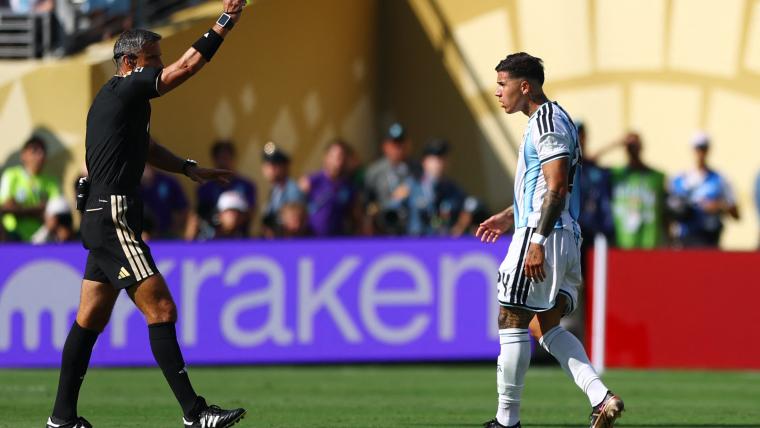
Argentina’s hopes of securing the 2026 FIFA World Cup title suffered a significant setback in the second half of the final against Spain, as midfielder Enzo Fernandez was sent off after accumulating two yellow cards. The incident leaves the South American side with ten players for the remainder of the scoreless contest, complicating their defensive efforts against a Spanish side ranked second in the world.
The first caution was issued to Fernandez for dissent after he gestured towards the referee in response to a perceived no-call. The second yellow card followed shortly after, resulting in a red card and a mandatory sending off, for a foul committed on a Spanish player after the ball had already been played away from the area.
The match, scheduled for 20 July 2026, has been characterised by a tense and physical atmosphere. Prior to Fernandez’s dismissal, Slovenian referee Slavko Vincic had issued the first booking of the game in the 40th minute to Argentina defender Lisandro Martinez. Spain had also lodged complaints regarding a challenge by Alexis Mac Allister in the 15th minute, though no booking was issued for that incident.
Both of Fernandez’s infractions were deemed clear by the match officials, and a subsequent Video Assistant Referee (VAR) review confirmed the decision, finding no grounds to overturn the sending off. Under standard football regulations, two yellow cards in a single match result in a red card, a rule that Fernandez now must adhere to as Argentina attempts to maintain their defensive structure.
Argentina reached the final by defeating England 2-1 in the semi-final in Atlanta on 15 July 2026. Spain, seeking its first World Cup title since 2010, remains level with Argentina at 0-0 as the match progresses with the numerical disadvantage.