Apple’s 2026 Studio Display update fails to justify premium price amid fierce rival competition
Linxi News analysis: Apple’s latest monitor lineup faces significant headwinds from competitors offering superior ergonomics, connectivity, and value in the 27-inch 5K segment.
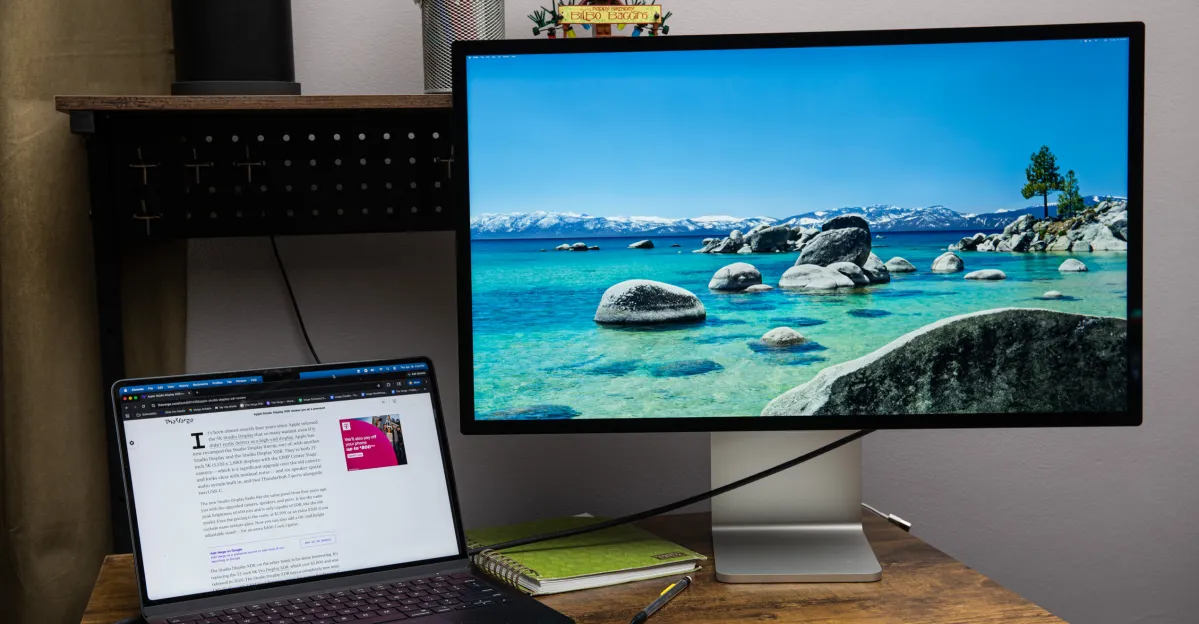
Apple has released updated versions of its Studio Display lineup in 2026, introducing a revised standard model and a new high-end XDR variant. The standard Studio Display, priced at $1,600, retains the original 2022 edge-lit IPS panel and 60Hz refresh rate but upgrades internal components, including an A19 chip, improved webcam, and Thunderbolt 5 connectivity. The new Studio Display XDR, priced at $3,300, introduces a mini-LED backlight, quantum-dot optical stack, and a 120Hz refresh rate. Despite these updates, the devices face intense competition from rivals such as BenQ, Asus, and KTC, which offer 27-inch 5K monitors at significantly lower price points ranging from $550 to $1,100.
Competitors are noted for superior ergonomics, broader port variety including HDMI and KVM support, and better value, with the BenQ MA270S frequently cited as a preferred alternative for its flexibility. The standard Studio Display’s base model comes with a tilt-only stand or a VESA mount option, but a height-adjustable stand costs an additional $400. In contrast, rival monitors from BenQ and Asus feature stands that pivot, rotate, and adjust in height, with removable designs that allow for easier VESA arm integration. This lack of flexibility in Apple’s base offering is a notable drawback for users requiring versatile desk setups.
Port selection remains a point of contention for the standard Studio Display. While the 2026 model now includes two Thunderbolt 5 ports and two USB-C ports, it lacks HDMI, DisplayPort, USB-A, audio out, and KVM functionality. Users must control settings via the connected Mac, with no physical power button or on-screen controls. Competitors such as the BenQ PD2730S and MA270S offer Thunderbolt 4 connectivity alongside HDMI ports and KVM switches, allowing users to connect multiple computers and switch peripherals seamlessly. This connectivity advantage is particularly valuable for professionals managing mixed ecosystems.
Colour accuracy remains a strength for Apple’s monitors, with the 2026 standard model performing well in sRGB mode. However, the BenQ PD2730S matches this accuracy and includes a calibration report, while the BenQ MA270S and Asus ProArt PA27JCV offer sufficient performance for most professional tasks. The Studio Display suffers from black levels that appear grey in dark environments, whereas BenQ monitors provide deeper blacks. Although Apple’s nano-texture glass option effectively reduces reflections, BenQ’s matte panels on the PD2730S offer comparable performance without the premium cost.
The market landscape for 5K monitors has evolved significantly since Apple’s initial 2022 release. With competitors now offering mini-LED and high-refresh-rate panels at lower prices, such as the LG 27GM950B and Asus ROG Strix XG27JCG, the standard Studio Display’s value proposition is weakened. Upcoming technologies, including 120Hz 27-inch 5K OLED monitors from LG Display and Samsung Display, further challenge Apple’s position. Unless users prioritise Apple’s specific design aesthetic, the data suggests that competitors provide more robust features and better value for money in the current market.
