AMD expands Ryzen PRO 9000 series with 3D V-Cache for commercial workstations
The chipmaker’s refreshed commercial lineup targets simulation and rendering workloads, though availability remains limited to specific models in the second half of the year.
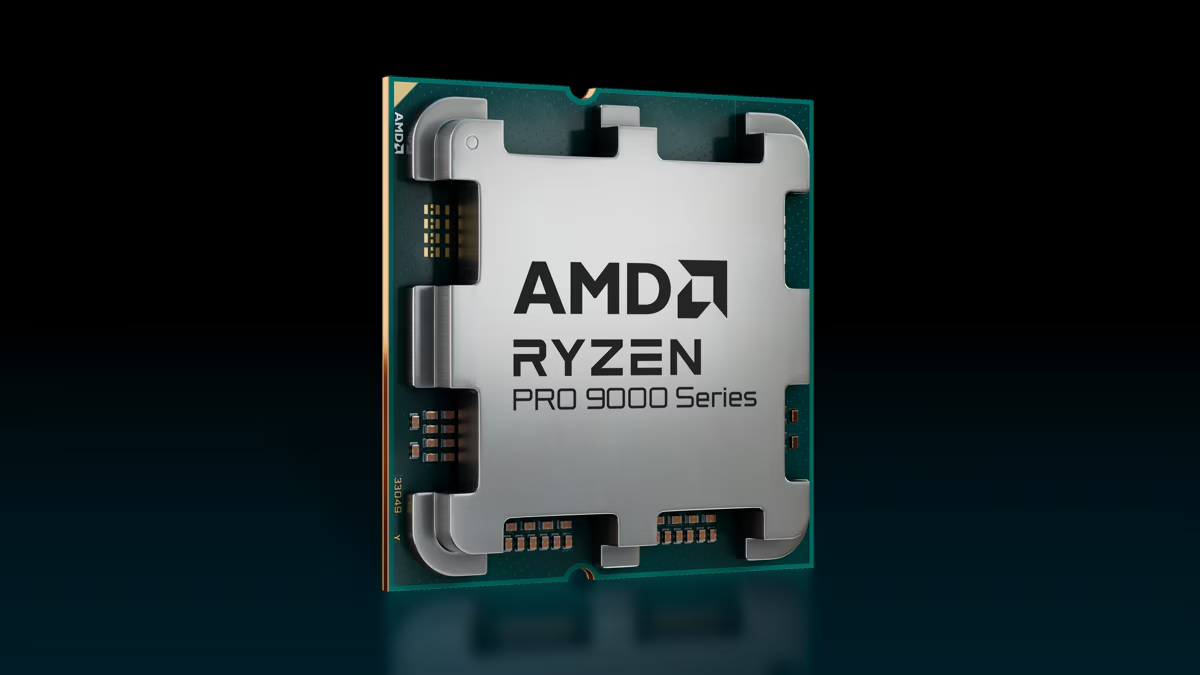
AMD has announced a refreshed line of Ryzen PRO 9000 series commercial workstation processors, marking the first time the company is incorporating its 3D V-Cache technology into its commercial workstation portfolio. Previously reserved for gaming CPUs, the 3D V-Cache feature is now being integrated into the Zen 5-based architecture to address complex, data-intensive professional workloads.
The new processors feature core counts ranging from 6 to 16, with thread counts between 12 and 32. The series supports up to 256GB of ECC DDR5 memory and includes PCIe 5.0 connectivity. While the entire Ryzen PRO 9000 series will utilise the Zen 5 architecture, AMD confirmed that only select models within the lineup will include the 3D V-Cache enhancement.
According to the company, the inclusion of 3D V-Cache is designed to improve performance in tasks such as simulation, rendering, and real-time visualisation. This shift aligns with growing industry recognition of the technology’s utility beyond gaming, as recent assessments of AMD’s consumer chips have highlighted significant improvements in creator workloads compared to non-3D variants.
Commercial availability for the new chips is scheduled to begin in the second half of 2026. Early adopters will have access to the technology through partner hardware, with Lenovo confirming that the ThinkStation P4 workstation will launch in the third quarter of 2026. The ThinkStation P4 is expected to be among the first systems to utilise the new Ryzen PRO 9000 series processors.
The move represents a strategic expansion for AMD’s commercial offerings, bridging the gap between high-performance gaming hardware and enterprise-grade stability. By bringing 3D V-Cache to the PRO series, AMD aims to provide enhanced computational power for professionals requiring intensive data processing capabilities.
