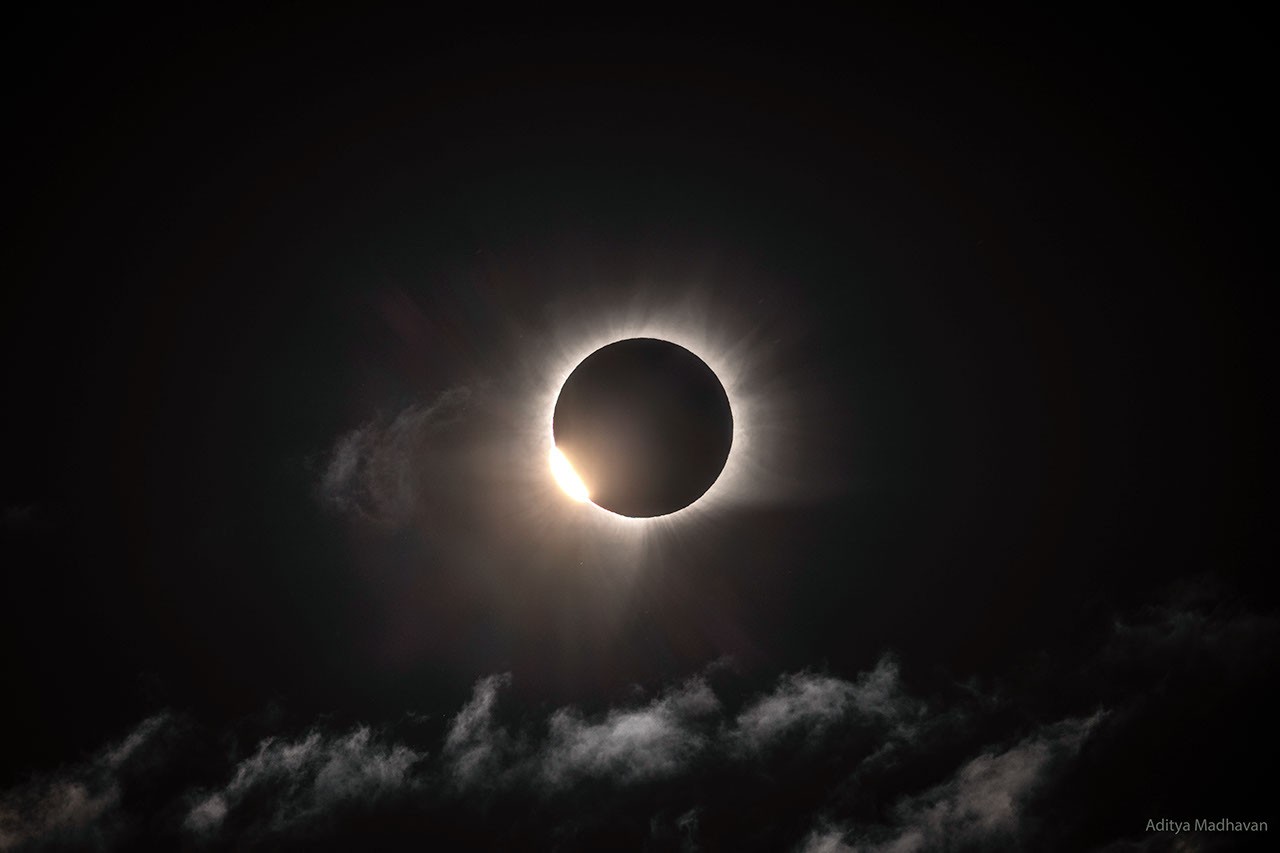
NASA APOD features hard-won eclipse shot from Greenland
The photograph, published by NASA’s Astronomy Picture of the Day service on 14 August 2026, shows the total solar eclipse of 12 August 2026 as it traversed the Arctic and Europe.
Event
On 12 August 2026, a total solar eclipse traversed the Arctic Ocean, Greenland, Iceland, the Atlantic, Portugal, and northern Spain. A photograph taken at 17:33:26 UTC along Rype Fjord on Greenland’s east coast captured the transient diamond ring effect and the solar corona emerging as totality began. The image, credited to Aditya Madhavan, was published by NASA’s Astronomy Picture of the Day service on 14 August 2026.
2 published stories · artificial-intelligence · source reliability 33%

The photograph, published by NASA’s Astronomy Picture of the Day service on 14 August 2026, shows the total solar eclipse of 12 August 2026 as it traversed the Arctic and Europe.
Background
On 12 August 2026, a total solar eclipse traversed the Arctic Ocean, Greenland, Iceland, the Atlantic Ocean, Portugal, and northern Spain. A photograph capturing the diamond ring effect and emerging solar corona at Rype Fjord, Greenland, was taken by Aditya Madhavan at 17:33:26 UTC. NASA’s Astronomy Picture of the Day (APOD) service published this image on 14 August 2026. The APOD service is a daily feature provided by NASA, resulting from a collaboration between the Astrophysics Science Division at NASA Goddard Space Flight Center, NASA Science Activation, and Michigan Technological University. A separate APOD feature on 13 August 2026 highlighted images of the same eclipse taken over Spain by Ruiyu Zhang.
On 12 August 2026, a total solar eclipse traversed the Arctic Ocean, Greenland, Iceland, the Atlantic Ocean, Portugal, and northern Spain. A photograph capturing the diamond ring effect and emerging solar corona at Rype Fjord, Greenland, was taken by Aditya Madhavan at 17:33:26 U
Fact cards
Key entities: NASA, Aditya Madhavan, Rype Fjord, Greenland, Iceland, Portugal, Spain.
What is the NASA Astronomy Picture of the Day (APOD) service? It is a daily feature showcasing an image or photograph of the universe with an explanation written by a professional astronomer. Who operates the APOD service? It is a collaboration between the Astrophysics Science Di
NASA News Releases | https://science.nasa.gov/image-article/apod/apod-2026-august-14-total-solar-eclipse-from-greenland | published 2026-08-14T04:05:00.000Z | primary source | NASA News Releases | https://science.nasa.gov/image-article/apod-2026-august-13-total-solar-eclipse-over
2026-08-12T17:33:26Z: Aditya Madhavan captures the diamond ring effect and solar corona at Rype Fjord, Greenland, during the total solar eclipse. 2026-08-13: NASA’s APOD service publishes images of the eclipse taken over Spain by Ruiyu Zhang. 2026-08-14: NASA’s APOD service publi
Timeline
Aditya Madhavan captures the diamond ring effect and solar corona at Rype Fjord, Greenland, during the total solar eclipse.
NASA’s APOD service publishes images of the eclipse taken over Spain by Ruiyu Zhang.
NASA’s APOD service publishes the photograph taken by Aditya Madhavan in Greenland.
FAQ
It is a daily feature showcasing an image or photograph of the universe with an explanation written by a professional astronomer.
It is a collaboration between the Astrophysics Science Division at NASA Goddard Space Flight Center, NASA Science Activation, and Michigan Technological University.
It was taken along Rype Fjord on the east coast of Greenland.
The total solar eclipse of 12 August 2026, specifically the diamond ring effect and the solar corona emerging as totality began.
It was the first major total solar eclipse observed in Spain since 1905.
In Zaragoza, Spain, capturing the eclipse over the Cathedral-Basilica of Our Lady of the Pillar and the Ebro River.
Ruiyu Zhang.
It allows scientists to study why the solar corona is millions of degrees hotter than the Sun’s surface.
Witnesses may notice a chill in the air, quieting of birds, and confused insect chirps.
By recording wildlife responses, imaging the corona, and monitoring air temperature and clouds.