Ukraine drone maker claims one-off test saw AI kill Russian soldiers
While full autonomy remains rare and controversial, Kyiv is rapidly integrating AI modules to counter electronic warfare, boosting strike success rates significantly.
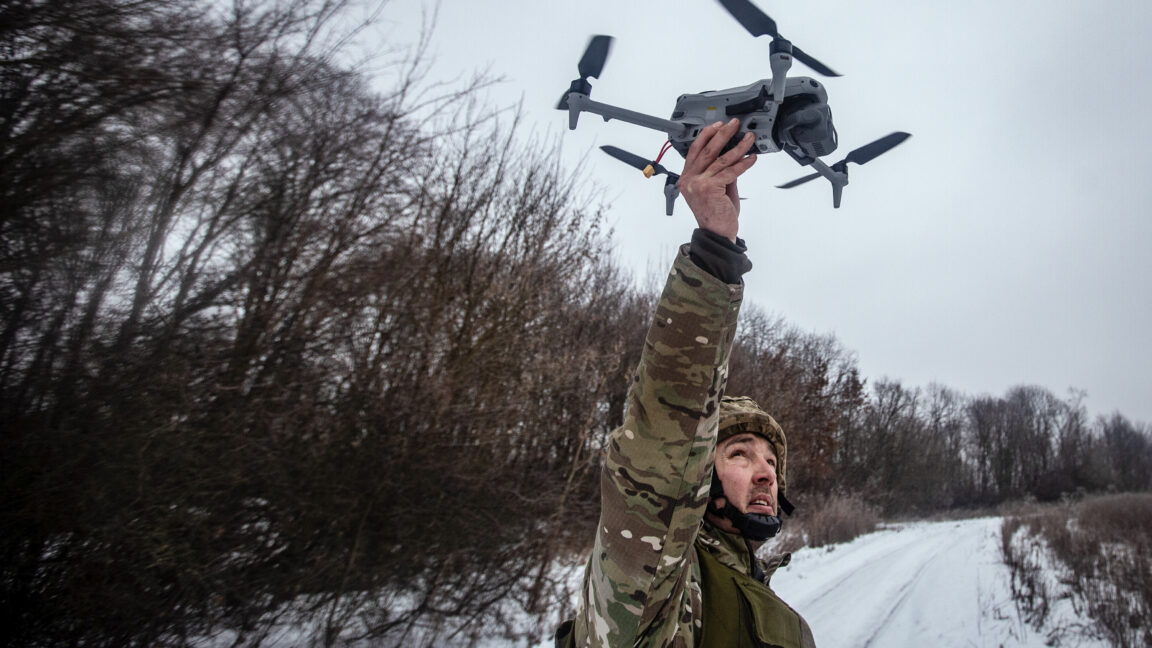
Alexander Kokhanovskyy, chief executive of Ukrainian drone manufacturer Aero Center, has revealed that fully autonomous drones killed Russian soldiers during a single battlefield test conducted two years ago. Speaking to New Scientist at a press event hosted by the Ukrainian embassy in London, Kokhanovskyy described how quadcopter drones were preprogrammed to fly to a front-line area before activating an AI-powered "Terminator mode" to seek and attack targets without human intervention.
There is no video footage or other evidence confirming what the autonomous drones specifically targeted or attacked. However, Kokhanovskyy stated that human-piloted drones deployed to assess the aftermath found "a couple" of dead Russian soldiers, leading to the conclusion that the fully autonomous systems were responsible for the fatalities. The incident is characterised as a one-time test rather than a standard operational procedure.
A Ukrainian military commander confirmed to New Scientist that current drone operations rely on semi-autonomous systems where humans make crucial control decisions. The commander emphasised Ukraine’s commitment to international humanitarian law, noting that the military exercises great care in decision-making to prevent civilian casualties. This stance aligns with broader industry trends where full autonomy in lethal weapon systems remains rare due to legal and practical constraints.
The integration of artificial intelligence into Ukrainian drone fleets is largely driven by the need to counter Russian electronic warfare and GPS jamming, which frequently disrupt communication links between human operators and drones. According to a report by Kateryna Bondar, a former Ukrainian government advisor, for the Center for Strategic and International Studies, this AI-driven navigation has boosted the success rate of mid- and long-range strike drones from 10–20 per cent to 70–80 per cent.
Ukraine’s defence industry has focused on training small AI models on small datasets to run on inexpensive chips, allowing for standalone hardware modules to be installed on first-person view drones and other platforms. While fully autonomous systems are not yet a battlefield reality, drones are gaining specific autonomous capabilities for navigation and targeting while retaining human control, a trend also observed in Russian Shahed drone variants equipped with Nvidia Jetson Orin microcomputers.
