Sotheby’s T. Rex Auction Highlights Tension Between Private Wealth and Scientific Access
Paleontologists argue that when rare specimens enter private hands, they become inaccessible for validation and future study, despite auction houses’ claims that sales rescue fossils from erosion.
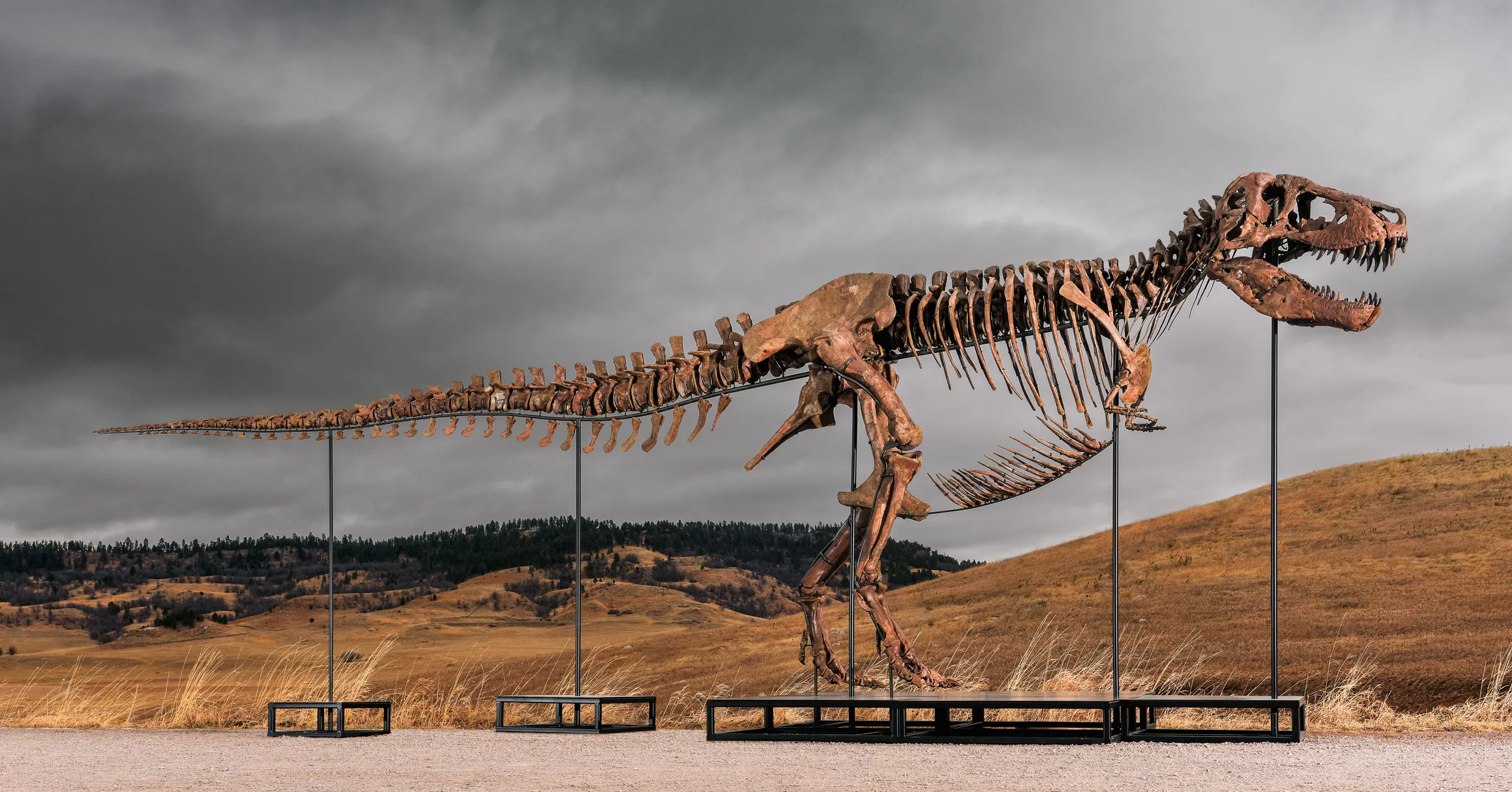
Sotheby’s is set to open live bidding on a collection of fossils on July 14, with the primary focus on lot 20: a 67-million-year-old Tyrannosaurus rex skeleton nicknamed Gus. Discovered on a ranch in South Dakota, the specimen comprises approximately 183 fossil bone elements, making it roughly 61 per cent complete by bone count. Expected to fetch up to $30 million, the auction has reignited a debate among scientists regarding the increasing trend of private collectors acquiring rare fossils, a shift that experts argue removes critical data from public scientific study.
The market for dinosaur fossils in the United States began to expand significantly following the 1997 auction of Sue, the most complete T. rex on record at the time, which sold for approximately $8.4 million to the Field Museum in Chicago. Court cases surrounding that sale clarified that fossil ownership in the US generally lies with the landowner, a legal framework that contrasts with many other countries where the state retains ownership. Since then, the market has boomed, with recent high-profile sales including a Stegosaurus named Apex, sold to hedge fund billionaire Ken Griffin for $44.6 million in 2024, and the only known juvenile Ceratosaurus, which sold for $30.5 million last year.
A study published in 2025 indicates that there are now more T. rex fossils in private collections than in public trusts. This shift has prompted concern among paleontologists, who contend that when specimens enter private hands, they become inaccessible for long-term study, data validation, and future scientific advancements. While auction houses argue that sales rescue fossils from erosion and ensure expert excavation, scientists warn that commercial excavation often lacks rigorous documentation of geological context, and artistic mounting can hinder modern imaging techniques such as computed tomographic scans.
Cassandra Hatton, vice chairman at Sotheby’s, defended the auction house’s role, stating that sales help rescue fossils from erosion and ensure expert excavation and preparation. However, researchers argue that the incentive to sell to the highest bidder undermines science by prioritising market appeal over scientific rigour. For instance, Sotheby’s description of Gus includes claims of tyrannosaurid bite marks on the jaw, a interpretation that experts like Stuart Sumida, president of the Society of Vertebrate Paleontology, dispute. Sumida notes that the holes in Gus’ bones are perfectly round and smooth-edged, characteristics more consistent with infections than puncture wounds, yet the auction description offers no evidence to support the dramatic narrative.
The central issue for the scientific community is that established journals typically require specimens to be in the custody of publicly accessible museums to publish studies, ensuring perpetual access for validation. To address the growing volume of private acquisitions, the Society of Vertebrate Paleontology is working to establish a liaison between private collectors and museums. Led by Sumida and vice president Kristi Curry Rogers, the society aims to encourage private buyers to donate acquired fossils to public institutions to preserve them for science, recognising that a scientifically important fossil is a permanent source of data for future generations.