Roscosmos pushes Amur-LNG reusable rocket debut to 2031 amid development delays
As Western competitors normalise orbital reuse, Russia’s Amur-LNG programme faces significant timeline setbacks, with full flight tests now projected for 2031.
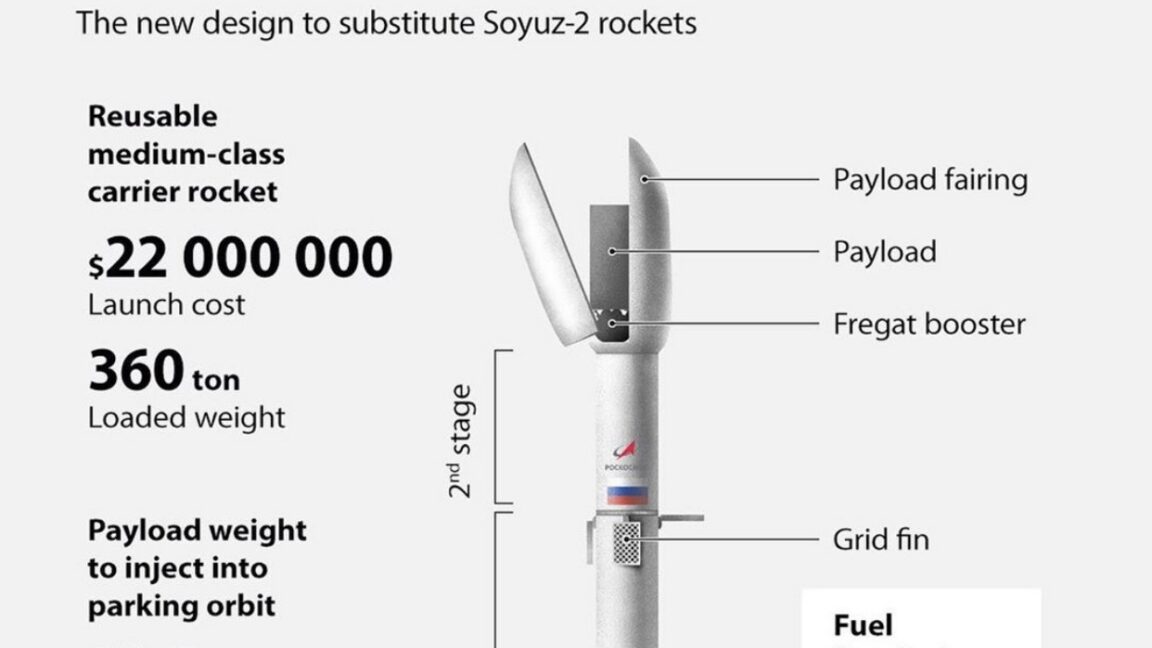
Roscosmos has confirmed a substantial delay in the development of its Amur-LNG reusable rocket, pushing the vehicle’s debut from the original 2026 target to a later date. Dmitry Baranov, the agency’s Deputy Director General for Rocket Programs, stated that current development efforts are prioritising a “demonstrator” hopper vehicle for the first stage, with initial vertical take-off and landing tests scheduled to commence in 2028.
The demonstrator programme involves two distinct test phases. The first will see the vehicle ascend to an altitude of less than 1 km with continuous engine operation before returning to the launch site. A second, more complex test is planned for later in 2028, involving an ascent to 10 km, engine shutdown, and a landing on deployable legs. These steps are intended to validate the technology before the full-scale rocket enters flight testing.
The Amur-LNG was unveiled in 2020 as a direct response to SpaceX’s Falcon 9, featuring a reusable first stage and methane-powered engines designed to deliver 10.5 metric tons to low-Earth orbit. The rocket is intended to eventually replace the Soyuz 2, which currently serves as the primary workhorse for Russian crew and cargo launches to the International Space Station. However, the RD-0169A engine intended to power the Amur remains in the preliminary stages of test firings, according to Roscosmos officials.
The revised timeline highlights a significant gap between Russian ambitions and Western capabilities. While previous indications from May 2026 suggested full flight tests might commence in 2031, this marks a five-year delay from the initial 2026 target. The delay comes as global competitors advance rapidly, with China recently joining the club of nations capable of landing orbital boosters, and Japanese entities such as Honda and JAXA conducting their own reuse tests.
In the United States, reusable rocket technology has become routine, with SpaceX landing orbital boosters every few days and other firms like Blue Origin, Rocket Lab, and Relativity Space making credible progress. Analysts note that the Amur-LNG is unlikely to arrive for at least two decades after SpaceX first achieved orbital rocket landing, raising questions about the competitiveness of Russia’s reusable space ambitions in the current market.