Penn State researchers develop painted conductive ink for wearable biosensors
A water-based ink developed by scientists at Pennsylvania State University can be painted directly onto the skin to create functional electrodes for biomonitoring, offering improved signal accuracy and flexibility over traditional e-tattoos.
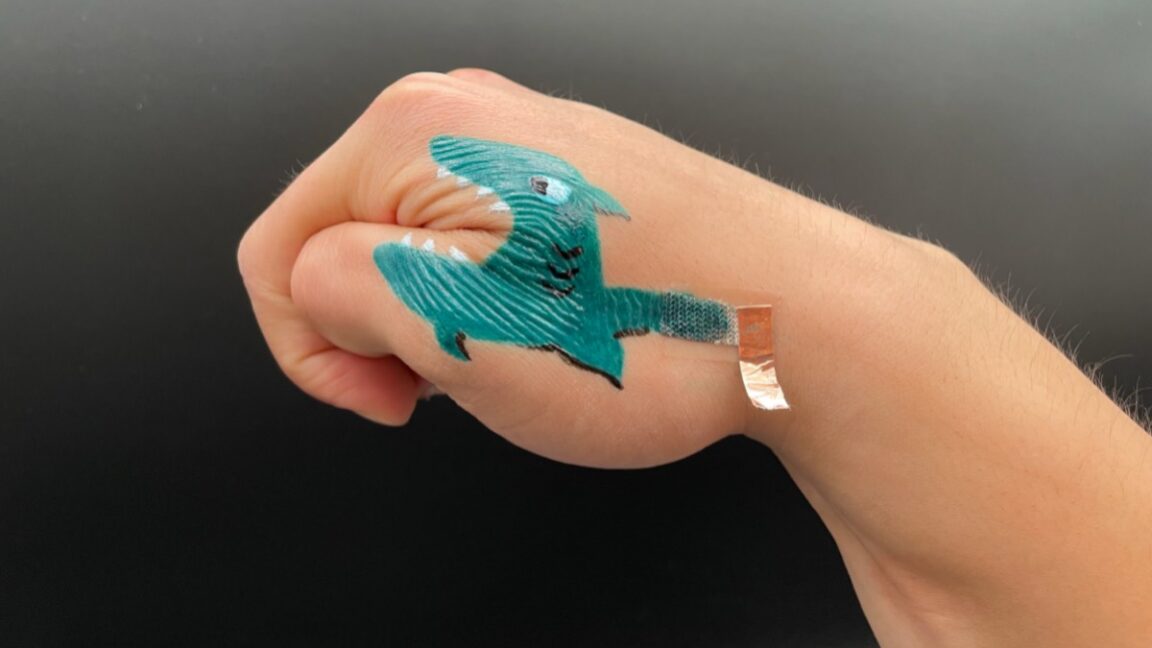
Scientists at Pennsylvania State University have developed a novel conductive ink, dubbed WE-PPD, which can be painted directly onto the skin to create functional electrodes for biomonitoring. Published in the Proceedings of the National Academy of Sciences (PNAS), the water-based ink uses polymers and acidic additives to provide electrical conductivity and flexibility. Unlike prefabricated e-tattoos, the ink fills skin contours to improve signal accuracy and can be pigmented with food dye for custom designs.
Lab tests on human subjects demonstrated its efficacy in monitoring heart activity during exercise, controlling prosthetic hands via gesture recognition, and recording brain waves through hair. The sensors stretch up to 170 percent, allow water vapour permeability, and caused no skin irritation over 12-hour tests. The team has filed a provisional patent, though comprehensive safety evaluations regarding RF-induced heating are required before clinical deployment.
The technology addresses limitations inherent in existing epidermal electronics, which often struggle on curved or hairy surfaces and can create air gaps that weaken sensor readings. By mixing polymers and acidic additives in a water-based ethanol/polyvinyl alcohol solution, the researchers created an ink that behaves like face paint. It starts transparent but can be coloured with food dye to create custom designs, such as cartoons or logos, allowing for personalisation.
Penn State mechanical engineer Larry Cheng, a co-author of the new PNAS paper, noted that the ink’s ability to conform to skin contours results in high skin connectivity and better signal recording. The painted sensors can be washed away and reapplied, suggesting a model where expensive sensing modules remain separate while electrodes are disposable. A single bottle of ink could provide enough material for multiple electrodes over several days or a week.
While the absence of imaging artifacts holds promise for MRI imaging, the authors note that there still needs to be a comprehensive safety evaluation before deploying the painted sensors in a clinical setting. RF-induced heating is a particular concern, given the super-adhesive properties of the sensors. That’s a focus of future research, along with exploring the possibility of adapting the technology for plant health monitoring, since the painted sensors can conform so well to complex shapes.