Nature paper challenges Microsoft’s quantum computing breakthrough claims
Physicist Henry Legg argues Microsoft exaggerated findings and cherry-picked data, while the tech giant maintains its roadmap to a scalable quantum computer by 2029.
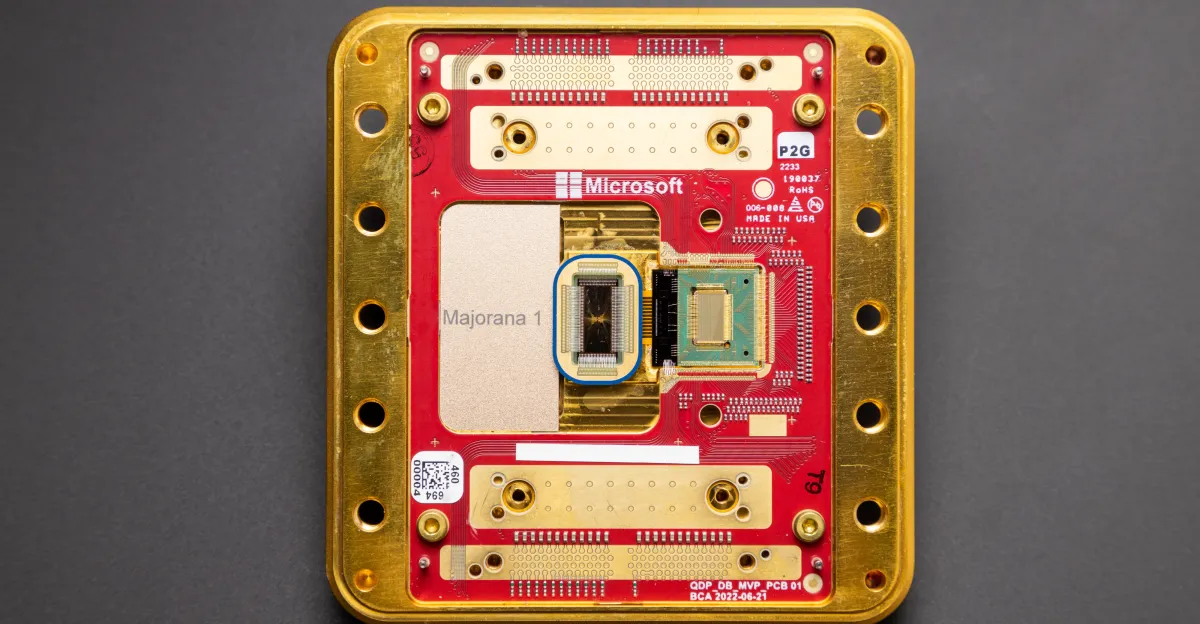
A peer-reviewed critique published in the journal Nature has cast doubt on Microsoft’s claims regarding its Majorana 1 quantum computing chip, arguing that the company failed to conclusively demonstrate a working topological qubit. The paper, authored by Henry Legg, a physicist at the University of St. Andrews, alleges that Microsoft exaggerated its findings and selectively presented data, suggesting the observed signals were more likely the result of quantum dot formation rather than the elusive Majorana particles the company relies on for its technology.
Legg’s analysis, which re-examined data from the device unveiled in February 2025, contends that Microsoft did not convincingly prove the existence of the Majorana particles necessary to build topological qubits. In his critique, Legg writes that the signatures Microsoft identified could instead be attributed to electron-containing structures known as quantum dots, which are not useful for constructing quantum computers. He further asserts that the company cherry-picked its data to support its narrative, stating, “You can’t make a qubit if you don’t have the Majoranas.”
Microsoft has firmly disputed these assertions, with its quantum team publishing a rebuttal in the same issue of Nature. Chetan Nayak, a physicist leading Microsoft’s quantum efforts, stated that Legg’s critique does not constitute a substantial scientific challenge. Nayak noted that Legg has not proposed an alternative model that fits all of the company’s data, and Microsoft maintains that its results are valid. “We 100% stand behind our results,” Nayak told The Verge, adding that the company stands by its roadmap and its long-standing commitment to scientific rigour.
The timeline of the dispute began shortly after Microsoft’s initial announcement, with Legg posting his critique on the online physics repository arXiv on 26 February 2025. It took a year for Nature to complete its peer review process and publish the article. Despite the growing scientific scrutiny, Microsoft proceeded with its development plans, announcing a next-generation chip, Majorana 2, at its Build conference earlier this month. The company continues to target a 2029 timeline for building a scalable quantum computer.
However, Legg remains unconvinced by Microsoft’s progress. He argues that the company’s characterisation of Majorana 2, detailed in a non-peer-reviewed manuscript, suffers from similar fundamental issues identified in his critique of the previous chip. Legg told The Verge that nothing in the new manuscript resolves the concerns raised by the scientific community regarding Microsoft’s previous claims, maintaining that the path to a practical quantum computer remains unproven.