NASA’s Psyche spacecraft executes critical Mars gravity assist en route to metallic asteroid
The Psyche probe utilised Mars’ gravitational pull to boost its speed to 12,300 mph, marking a pivotal milestone in its six-year journey to study the largest known metallic asteroid in the solar system.
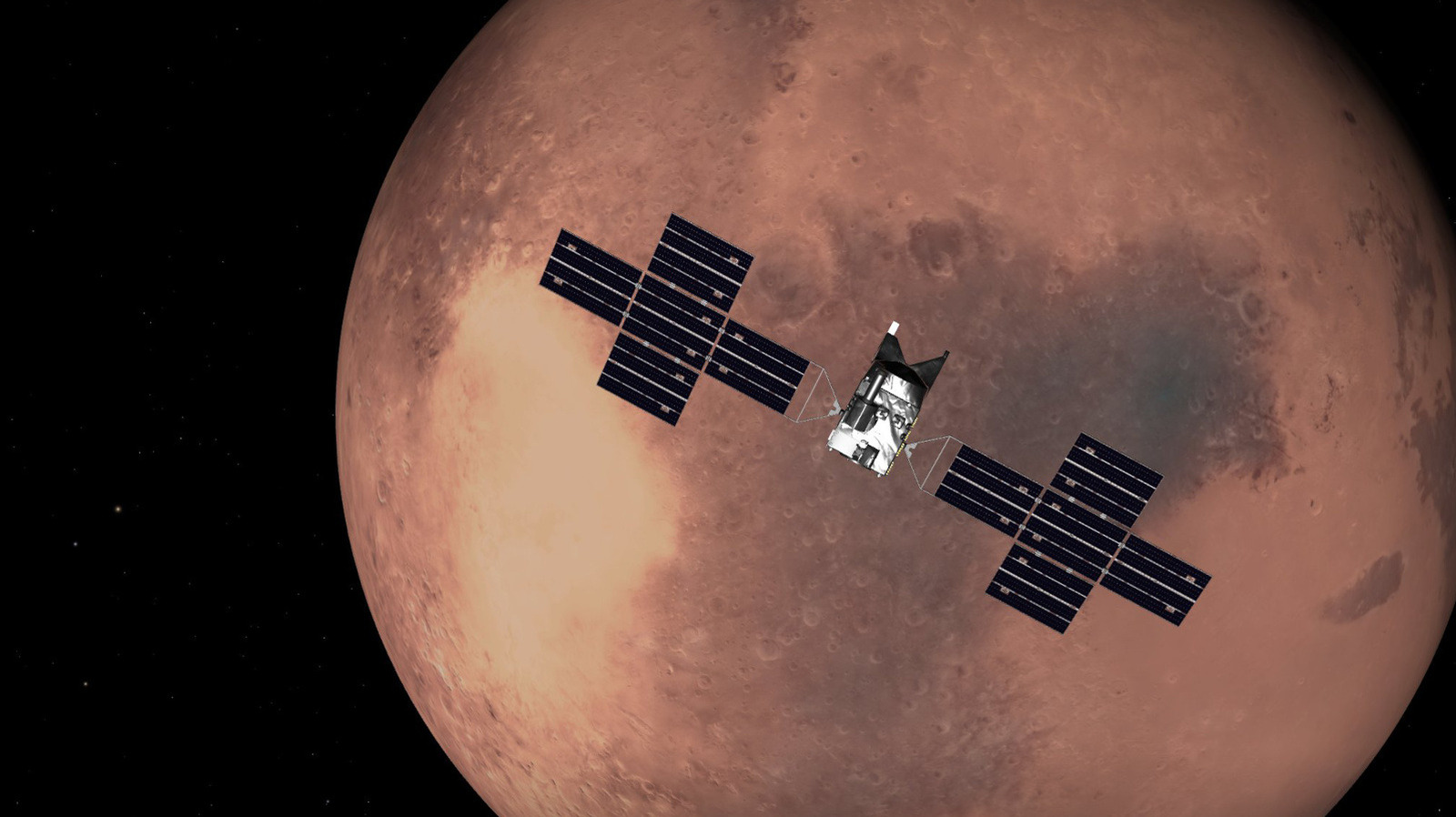
NASA’s Psyche spacecraft completed a planned gravity assist flyby of Mars on 15 May 2026, passing within 2,800 miles of the planet at a speed of 12,300 mph. The manoeuvre, executed at approximately 3:30 PM Eastern time, was designed to utilise the planet’s gravitational pull to boost the spacecraft’s velocity and refine its trajectory. This strategic flyby ensures the mission remains aligned with the orbit of its target, the metallic asteroid 16 Psyche, while conserving xenon propellant for the spacecraft’s solar-electric ion thrusters.
The spacecraft passed significantly closer to Mars than either of its natural satellites, which orbit at distances of 3,700 miles and 12,470 miles respectively. During the approach phase, which began in early May, Psyche captured images of the planet appearing as a bright, thin crescent. These visuals, transmitted back to Earth via NASA’s Deep Space Network, will be uploaded to the mission’s official page over the coming days and weeks as data processing continues.
Launched in late 2023, Psyche is undertaking a six-year, 2.2-billion-mile journey to the asteroid 16 Psyche. Upon arrival in July 2029, the spacecraft is scheduled to spend two years orbiting the body to map its surface and determine its composition. The asteroid is the largest known metallic asteroid in the solar system and is believed to be the exposed iron-rich core of a planetesimal, a solid building block of a planet formed in the early solar system.
Scientific objectives for the mission centre on understanding planetary formation. Because direct access to planetary cores is impossible, studying 16 Psyche offers a unique opportunity to examine the violent history of collisions and matter accumulation that created rocky planets like Earth. The data collected will help scientists reconstruct the processes that formed the cores of terrestrial planets.
While the gravity assist was a critical step in the mission’s logistics, the primary scientific data collection phase has not yet commenced. The spacecraft is expected to begin its orbital operations at the asteroid in August 2029, following the July arrival. The images captured during the Mars flyby serve as a visual confirmation of the spacecraft’s successful navigation through the inner solar system on its path to the metallic world.
