NASA’s Psyche spacecraft completes Mars flyby en route to metal-rich asteroid
The Psyche mission, launched in October 2023, utilised a close encounter with Mars to adjust its trajectory and test science instruments ahead of its journey to the asteroid belt.
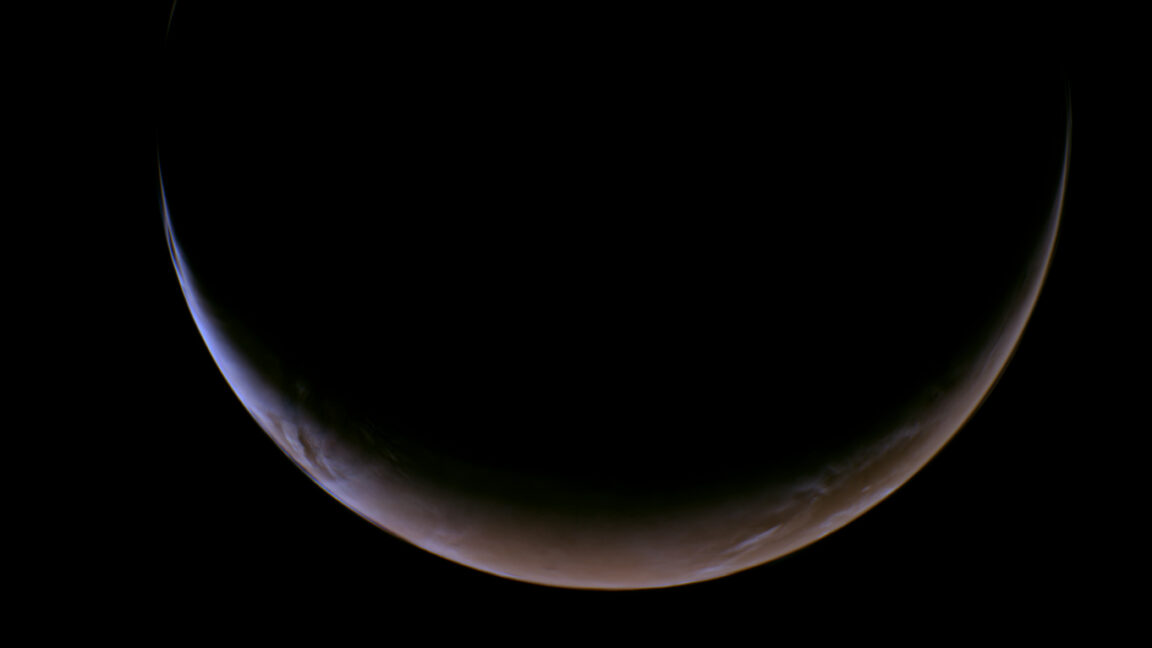
NASA’s Psyche spacecraft executed a gravity-assist flyby of Mars last Friday, passing within 2,864 miles (4,609 km) of the planet’s surface. The manoeuvre provided a speed boost of approximately 1,000 miles per hour and shifted the spacecraft’s orbital plane by about one degree relative to the Sun. This encounter served as a critical calibration exercise for the mission’s science instruments ahead of its scheduled arrival at the metal-rich asteroid Psyche in summer 2029.
The Psyche mission launched in October 2023 from Kennedy Space Center, Florida, aboard a SpaceX Falcon Heavy rocket. The spacecraft is currently halfway through a six-year journey covering 2.2 billion miles (3.6 billion km) to reach the asteroid Psyche, located in the asteroid belt between Mars and Jupiter. The mission utilises plasma engines to gradually build up the impulse required for its long-duration transit.
Don Han, navigation lead at NASA’s Jet Propulsion Laboratory (JPL), confirmed the orbital adjustments via real-time monitoring of the Deep Space Network’s Doppler signal. “Although we were confident in our calculations and flight plan, monitoring the DSN’s Doppler signal in real time during the flyby was still exciting,” Han stated. He confirmed that the gravity assist placed the probe on course for its 2029 destination.
During the flyby, the spacecraft captured images of Mars from a rare high phase angle, revealing the planet as a thin crescent with visible atmospheric dust. Jim Bell, who leads the imager instrument team at Arizona State University, stated that thousands of images were taken to help calibrate and characterise camera performance. The data collected includes inputs from the multispectral imager, spectrometers, and magnetometer.
Psyche’s magnetometer may have detected signatures of the solar wind interacting with Mars’ upper atmosphere or remnant magnetic field. While the flyby is not expected to yield major new scientific discoveries about the planet itself, as other spacecraft are permanently studying Mars, the encounter allowed scientists to compare flyby observations with archival data from other missions. The primary objective remains the detailed survey of the asteroid Psyche, a metal-rich object roughly the size of Massachusetts.
