LONGi sets new world record for crystalline silicon-perovskite solar cell efficiency
The latest milestone, verified by the European Solar Test Installation, highlights the rapid advancement of tandem photovoltaic technology ahead of its theoretical efficiency limit.
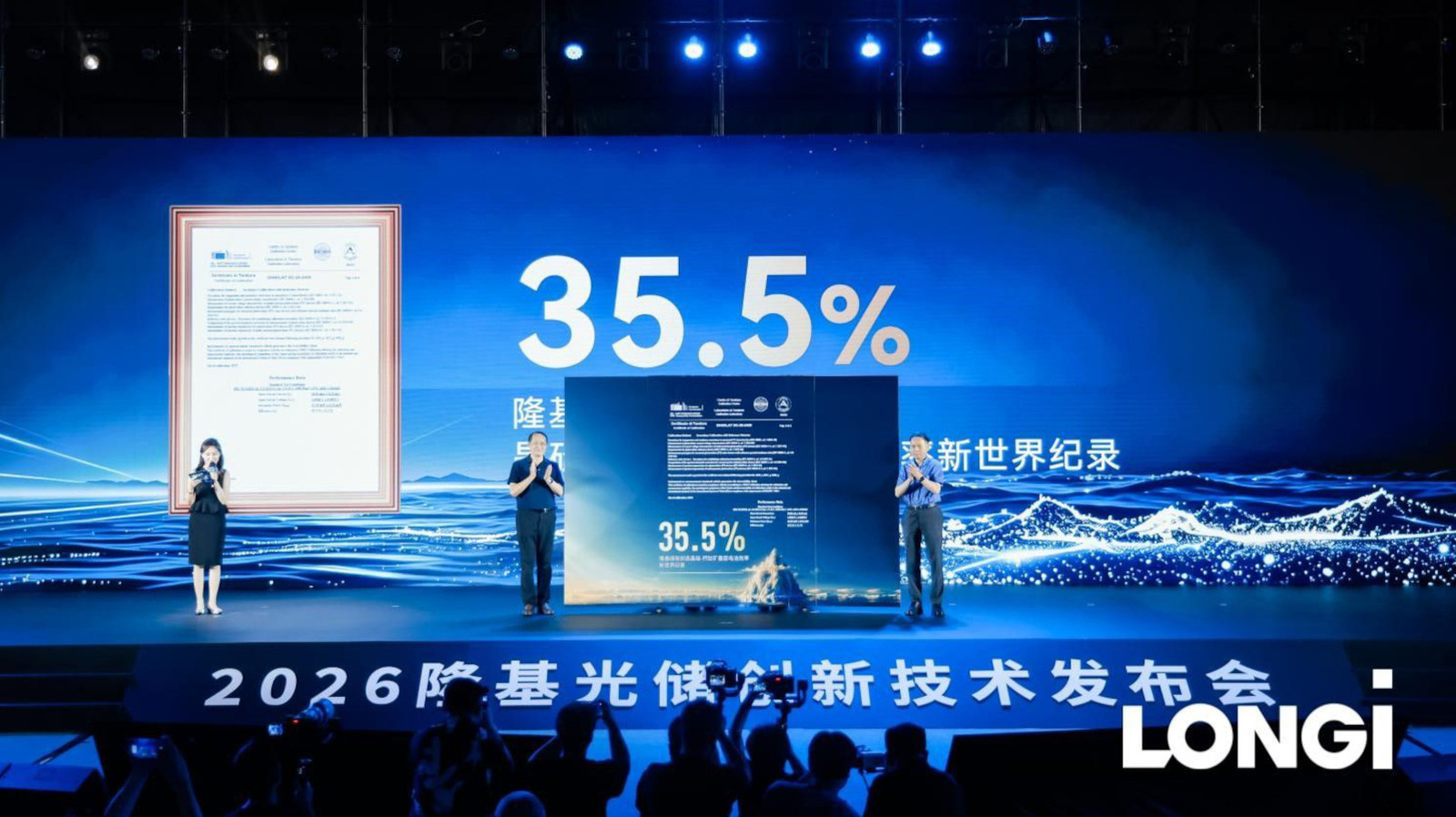
Chinese solar manufacturer LONGi has announced that its crystalline silicon-perovskite tandem solar cells have achieved a conversion efficiency of 35.5 per cent. The result was verified by the European Solar Test Installation, a recognised reference laboratory for the calibration of photovoltaic devices. This figure marks a significant progression for the company, surpassing its previous records of 33.9 per cent set in November 2023 and 34.6 per cent recorded in June 2024.
The development positions LONGi as the holder of the world record for this specific category of photovoltaic technology. The company states that crystalline silicon-perovskite tandem cells represent an emergent technology that it believes will define the future of solar energy. According to LONGi, this specific architecture has a theoretical efficiency limit of 43 per cent, suggesting considerable room for further improvement before reaching physical constraints.
Current market realities contrast sharply with these laboratory achievements. According to the US Energy Efficacy Administration, commercially available solar panels typically operate at a conversion efficiency of approximately 25 per cent. While some specialized cells have demonstrated efficiencies of up to 50 per cent, these are generally reserved for niche applications such as satellite power systems rather than terrestrial energy generation.
The pursuit of higher efficiency has seen rapid iteration from LONGi over the past 18 months. The progression from 33.9 per cent to the current 35.5 per cent demonstrates incremental gains in material science and cell architecture. However, the broader context of global records remains nuanced. The US Department of Energy’s National Renewable Energy Laboratory developed a solar cell with an efficiency of 39.5 per cent in 2022, though this achievement is not explicitly categorised as a crystalline silicon-perovskite tandem cell, creating ambiguity regarding the absolute global record versus the record for this specific technology.
Despite the technical milestones, the timeline for mass production and commercialisation of these high-efficiency cells remains unspecified. The primary challenge for the industry lies in translating laboratory results into scalable manufacturing processes that can address global energy demands. For investors and policymakers, the focus remains on when these efficiencies can move from verification to widespread deployment.

