JWST reveals ancient galaxy LAP1-B, offering glimpse into first stars
Observations of LAP1-B, magnified by gravitational lensing, suggest enrichment from Population III supernovae and provide a missing link in cosmic evolution.
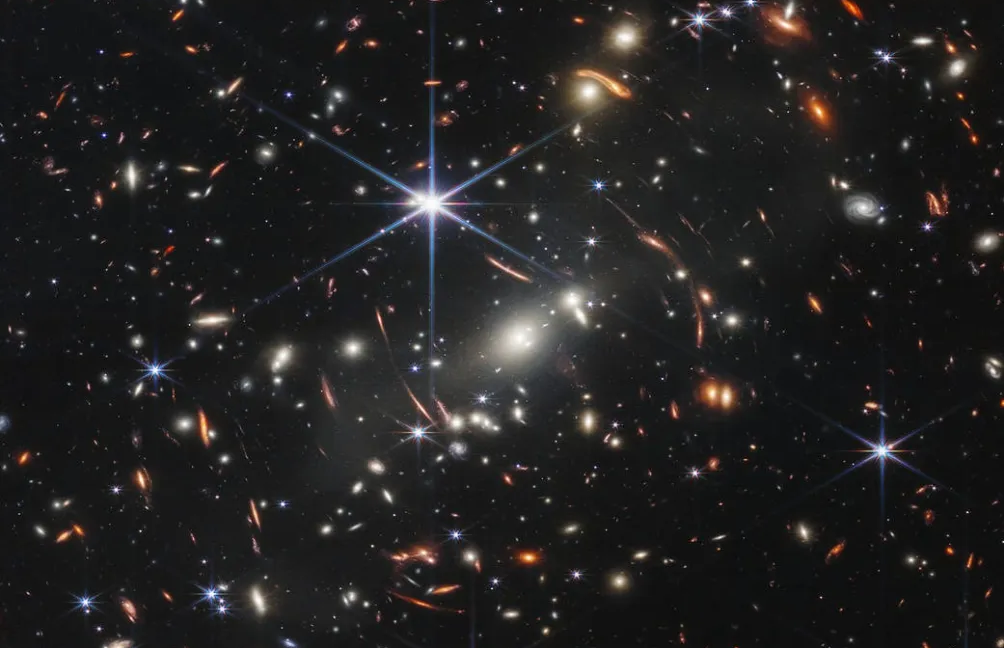
A research team led by Kimihiko Nakajima of Kanazawa University has identified LAP1-B, a galaxy existing approximately 800 million years after the Big Bang. Located 13 billion light-years from Earth, the galaxy was observed using the James Webb Space Telescope (JWST) and magnified by a factor of roughly 100 due to the gravitational lensing effect of the MACS J046 galaxy cluster. LAP1-B is described as the most chemically primitive galaxy ever observed, exhibiting extremely low oxygen levels and high carbon content.
Spectroscopic analysis of the galaxy's glowing gas reveals an oxygen-to-hydrogen ratio of just 0.4 per cent of solar levels. The team detected emission lines from triply ionized carbon, indicating the presence of extreme-ultraviolet photons with energies exceeding 47.9 electronvolts. This chemical signature suggests enrichment from the supernovae of Population III stars, the first generation of stars in the Universe, which may have died in "faint supernovae" with significant fallback.
The galaxy is estimated to have a stellar mass of less than 3,300 solar masses, with a total mass of approximately 10 million solar masses. This indicates that LAP1-B is dominated by a massive dark matter halo, which likely provided the gravitational scaffolding necessary for the galaxy to form. The gas within LAP1-B is swirling at approximately 58 kilometers per second, a velocity typical for dwarf galaxies.
LAP1-B is considered a potential "missing link" in cosmic evolution, resembling Ultra-Faint Dwarf galaxies that orbit the Milky Way but observed before the Epoch of Reionization likely ceased its star formation. While uncertainties remain regarding whether the intense radiation came from Population III or extremely massive Population II stars, the discovery offers significant insights into the first stars and galaxies.
The findings were published in the journal Nature in May 2026. Alexander Ji of the University of Chicago provided commentary in Nature, noting that while uncertainties remain, the discovery offers significant insights into the first stars and galaxies. Nakajima stated that the obvious next step is to find more metal-deficient galaxies, with work already underway.
