College Football Analysis Ranks Top Wide Receiver Duos for 2026-27 Season
A new ranking from Yahoo Sports/The Lead identifies the top 10 wide receiver combinations in US college football, citing historical precedents and projected offensive impact for the upcoming season.
Yahoo Sports/The Lead has published an analysis ranking the top 10 wide receiver duos in US college football ahead of the 2026-27 season. The assessment focuses on pairs capable of driving offensive success and competing for national championships, moving beyond individual player metrics to evaluate the strategic value of paired receivers.
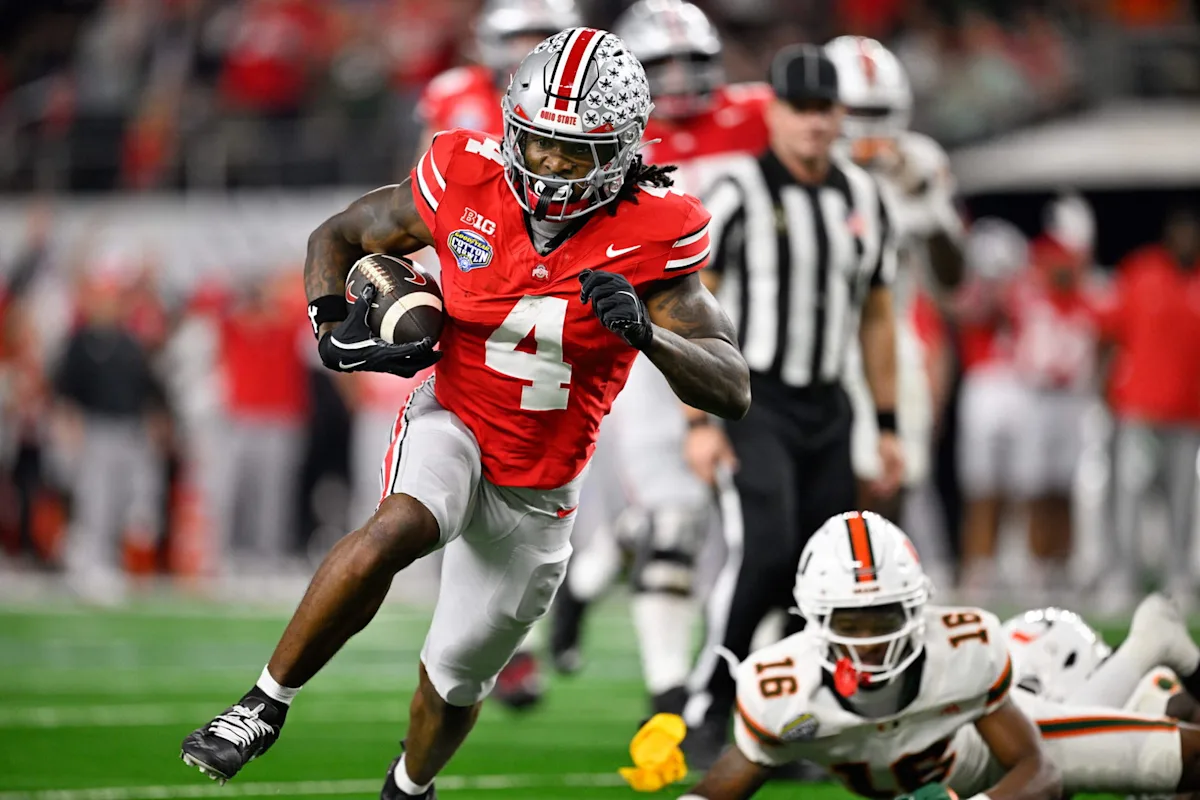
The article references historical benchmarks for successful pairings, including LSU’s Ja’Marr Chase and Justin Jefferson in 2019, and Ohio State’s Jeremiah Smith and Carnell Tate in 2025. These past collaborations are used to contextualise the potential impact of current duos on team performance and championship contention.
Notable duos highlighted in the ranking include Florida State’s Duce Robinson and Micahi Danzy, Clemson’s Bryant Wesco Jr. and TJ Moore, Indiana’s Charlie Becker and Nick Marsh, and Tennessee’s Braylon Staley and Mike Matthews. The analysis also features Texas’s Ryan Wingo and Cam Coleman, Miami’s Malachi Toney and Cooper Barkate, Oregon’s Dakorien Moore and Evan Stewart, and Ohio State’s Jeremiah Smith and Chris Henry Jr.
The evaluation criteria explicitly prioritise duo cohesion over individual stardom. Consequently, teams such as Michigan and USC were excluded from the list due to uncertainty surrounding their leading receiving options. The ranking suggests that consistent pairing provides offensive stability, particularly for programmes aiming to return to the College Football Playoff or defend national titles.
Player performance data from the 2025 season underpins many of the selections. For instance, Robinson’s 1,081 yards and Danzy’s all-purpose production are cited alongside Moore and Wesco’s combined yardage at Clemson. The analysis notes that these duos offer quarterbacks reliable targets, with specific emphasis on their ability to stretch the field and create mismatches against opposing secondaries.
The publication serves as a pre-season projection, acknowledging that roster compositions may shift due to transfers or injuries. However, the identified pairings represent the current consensus on which offensive weapons are best positioned to influence the 2026-27 college football landscape.