TechDraft
Anthropic expands Claude voice capabilities to Opus and Sonnet models
The update allows users to perform complex business tasks via voice and moves nine non-English languages out of beta.
Tech DeskRead story
Event
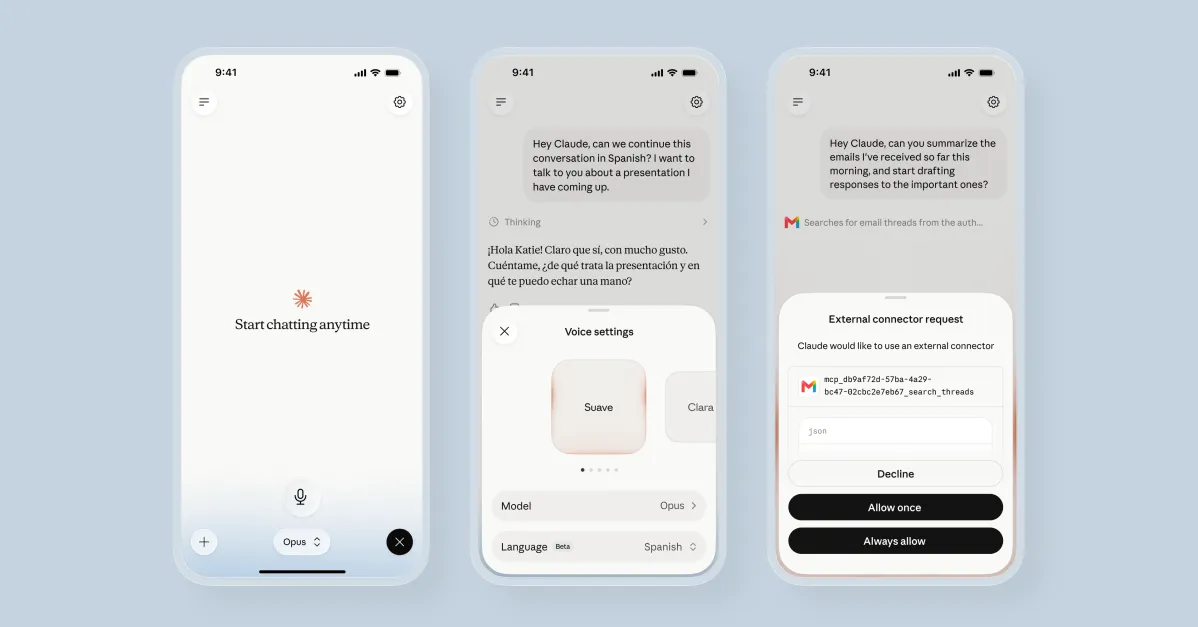
Anthropic has updated Claude’s voice mode to allow users to select from Opus, Sonnet, and Haiku models, moving beyond the previous Haiku-only limitation. The update enables voice interactions to integrate with external applications including Gmail, Google Calendar, Slack, Canva, and Notion, facilitating tasks such as rescheduling meetings, drafting emails, and creating documents. This functionality distinguishes Claude from OpenAI’s voice mode, which currently lacks tool-use capabilities. The update also expands multilingual support to include English, French, German, Hindi, Indonesian, Italian, Japanese, Korean, Portuguese, and Spanish. The new voice mode is available in beta across all platforms, though free users remain restricted to the Haiku model and a single connected application.
2 published stories · artificial-intelligence · source reliability 0%
The update allows users to perform complex business tasks via voice and moves nine non-English languages out of beta.
Background
Anthropic has expanded its Claude voice mode capabilities, allowing users to select from the Opus, Sonnet, and Haiku models, a significant upgrade from the previous Haiku-only restriction. This update introduces tool-use functionality, enabling voice interactions to integrate with external applications such as Gmail, Google Calendar, Slack, Canva, and Notion for tasks like rescheduling meetings and drafting emails. The feature is available in beta across all platforms and supports ten languages, including English, French, German, Hindi, Indonesian, Italian, Japanese, Korean, Portuguese, and Spanish. While paid users can access the full suite of models and multiple app connections, free users remain limited to the Haiku model and a single connected application. This development positions Claude competitively against OpenAI’s voice mode, which currently lacks comparable tool-use capabilities despite recent updates to its conversational style and the launch of ChatGPT Health in the US.
Anthropic has expanded its Claude voice mode capabilities, allowing users to select from the Opus, Sonnet, and Haiku models, a significant upgrade from the previous Haiku-only restriction. This update introduces tool-use functionality, enabling voice interactions to integrate wit
Fact cards
Key entities: Anthropic, Claude, OpenAI, ChatGPT, Gmail, Google Calendar, Slack, Canva.
Which models are now available for Claude’s voice mode? Users can select from Opus, Sonnet, and Haiku models. Can Claude’s voice mode interact with other apps? Yes, it integrates with Gmail, Google Calendar, Slack, Canva, and Notion. Is this feature available to free users? Free
Last year: Anthropic initially released Claude’s voice mode, powered exclusively by the Haiku model. Earlier this year: Anthropic added multilingual support to Claude’s voice mode in beta, requiring manual language specification. Recent weeks: OpenAI rolled out updates to ChatGPT
Timeline
Anthropic initially released Claude’s voice mode, powered exclusively by the Haiku model.
Anthropic added multilingual support to Claude’s voice mode in beta, requiring manual language specification.
OpenAI rolled out updates to ChatGPT’s voice mode, improving conversational style but retaining limitations on tool use.
OpenAI launched ChatGPT Health to US users, powered by the GPT-5.6 Sol model.
Anthropic announced the updated Claude voice mode, enabling model selection (Opus, Sonnet, Haiku) and integration with external applications.
FAQ
Users can select from Opus, Sonnet, and Haiku models.
Yes, it integrates with Gmail, Google Calendar, Slack, Canva, and Notion.
Free users can access the voice mode but are restricted to the Haiku model and one connected application.
Unlike OpenAI’s voice mode, Claude’s update includes tool-use capabilities for external applications.
The update supports English, French, German, Hindi, Indonesian, Italian, Japanese, Korean, Portuguese, and Spanish.
Opus, Sonnet, and Haiku.
Gmail, Slack, Canva, Notion, and Google Calendar.
French, German, Spanish, Hindi, Indonesian, Italian, Japanese, Korean, and Portuguese.
It was restricted to the Haiku model, which was not designed for deep conversations or complex tasks.