Alga research behind Nobel-winning optogenetics reshapes how scientists study the brain
The Karolinska Institute recognised Karl Deisseroth, Peter Hegemann and Georg Nagel for discoveries that made it possible to control neurons with light.
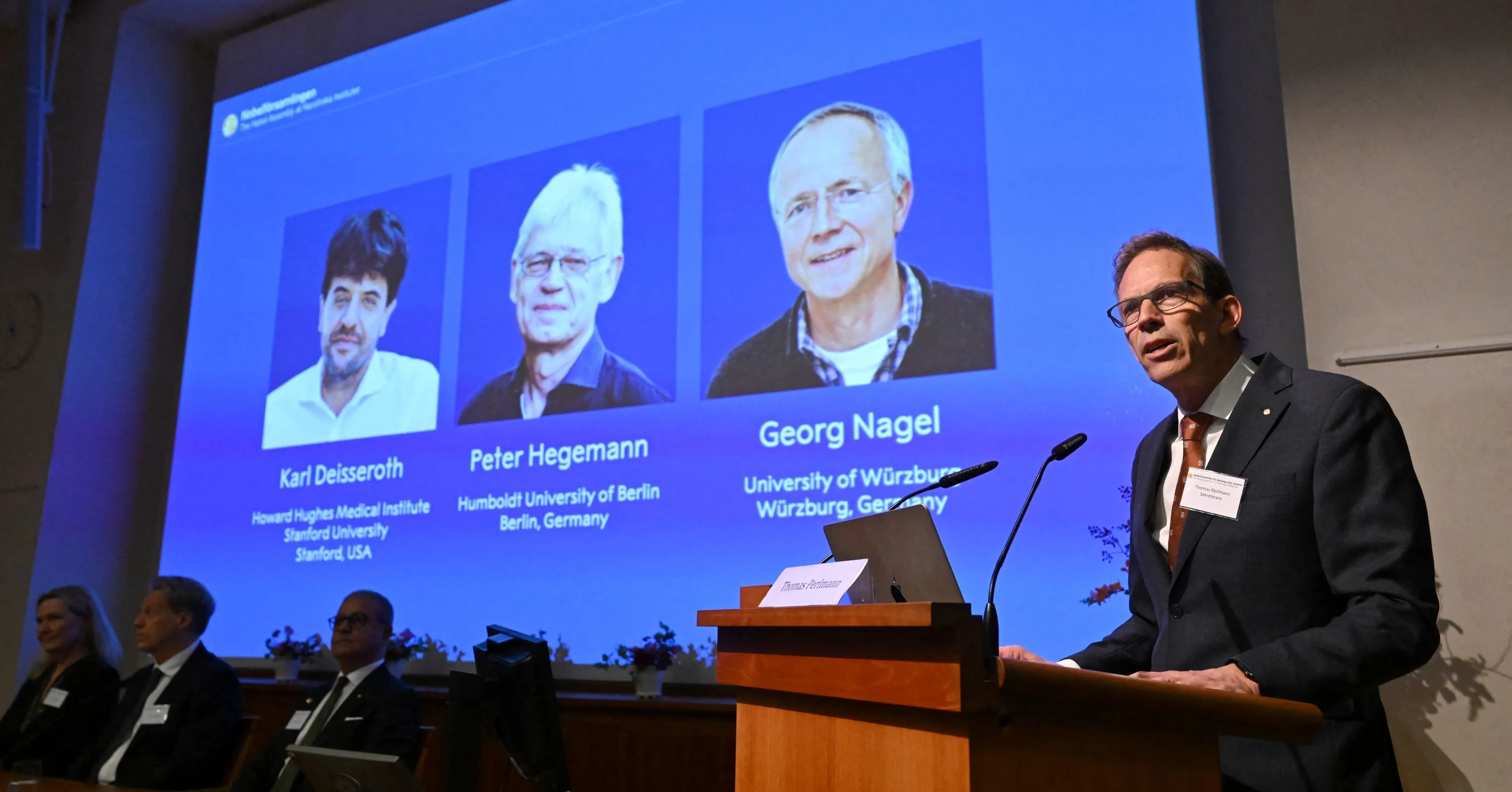
The 2026 Nobel Prize in Medicine has been awarded to Karl Deisseroth, Peter Hegemann and Georg Nagel for discoveries that enabled optogenetics, a technique that uses light to switch selected neurons on or off. The Karolinska Institute said the method has helped researchers map neural circuits.
The work began with Hegemann’s studies of Chlamydomonas, a single-celled alga that reacts rapidly to light. He proposed that proteins in the alga’s eyespot could detect light and open ion channels, allowing charged particles to pass through.
Nagel tested two candidate genes in frog eggs. The proteins they produced acted as light-sensitive ion channels, which he named channelrhodopsin-1 and channelrhodopsin-2. The second channel responded in 0.2 milliseconds.
In 2005, Deisseroth and colleagues showed that rat neurons expressing channelrhodopsin-2 could be activated with blue light. That result established the protein as a tool for neuroscience, where controlling ion flow offers a way to control neuron activity.
Researchers have since developed proteins that activate or deactivate neurons at different light wavelengths. The approach has been used to investigate circuits linked to memories, feelings and behaviours, while sight restoration remains an area of research rather than an established treatment.